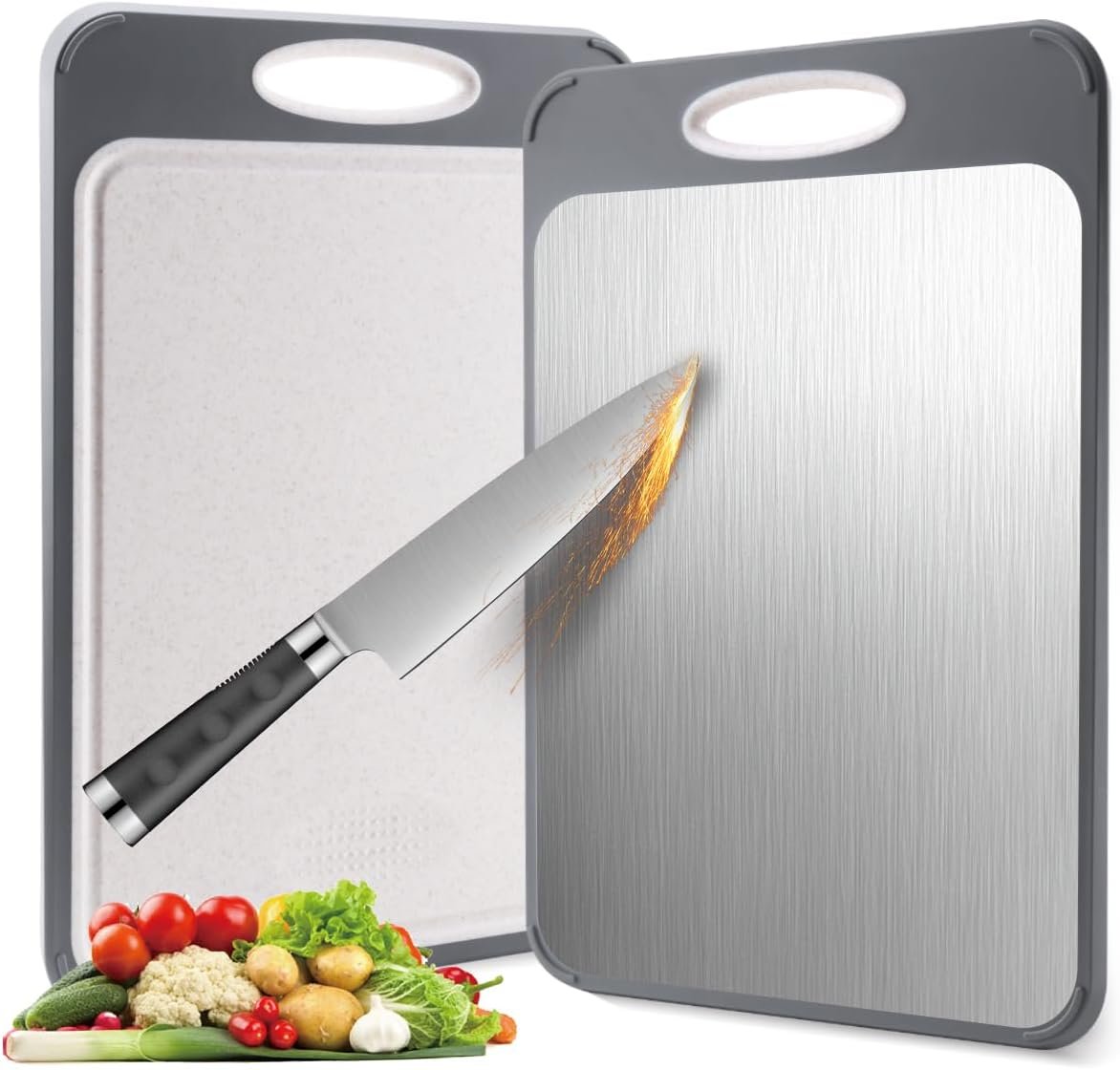
A cutting board is one of the most frequently used tools in a kitchen. Whether someone is preparing vegetables for a quick lunch, slicing fruit for breakfast, trimming meat for dinner, or chopping herbs for a recipe, the cutting board provides the working surface between the food and the countertop.
Choosing a cutting board, however, involves more than simply looking at its size or appearance. Material, cleaning requirements, food preparation habits, durability, storage, and cross-contamination concerns can all influence which type of board is appropriate for a particular kitchen.
The 2-in-1 Cutting Boards product discussed in this article uses a double-sided design combining 304 stainless steel and food-grade wheat straw. The concept gives users access to two different preparation surfaces within one kitchen accessory. It is also described with an easy-clean design and a juice groove intended to help manage liquid released by certain foods.
Having two distinct surfaces can be useful for households that want to separate certain food-preparation tasks or simply prefer different surfaces for different ingredients. Stainless steel offers a firm, non-porous working surface, while a wheat straw-based food-contact surface provides a different texture and feel for everyday chopping.
As with any cutting board, proper cleaning and food-handling habits remain important. A cutting board should not be considered automatically hygienic simply because of its material. The way it is used, cleaned, dried, and stored plays a significant role in maintaining a suitable food-preparation environment.
This guide examines the design and practical uses of a 2-in-1 cutting board, explains the differences between stainless steel and plant-based board materials, discusses the purpose of a juice groove, and compares this type of product with other common cutting-board categories.
What Is a 2-in-1 Cutting Board?
A 2-in-1 cutting board combines two preparation surfaces into one product.
Instead of having two completely separate boards, the user can access different materials on opposite sides of the same board.
For this particular product, the two-sided design combines 304 stainless steel with food-grade wheat straw.
The concept provides flexibility when preparing different types of food.
For example, one side may be used for ingredients that benefit from a firm stainless-steel surface, while the other can be used for general chopping and preparation tasks.
The two sides can also help create a more organized workflow.
A cook may designate one surface for particular ingredients and the other for different preparation tasks. However, users should still clean the board thoroughly between uses when appropriate. Simply switching sides does not eliminate the need for proper sanitation.
Key Features
Several features define the practical design of this cutting board.
304 Stainless Steel Surface
304 stainless steel is a commonly used stainless-steel grade across food-service and kitchen applications.
A stainless-steel cutting surface provides a firm, non-porous material that does not absorb liquids in the same way as porous wood or some softer board materials.
This can be useful when preparing ingredients that release moisture.
Stainless steel is also generally straightforward to wipe and clean.
However, stainless steel has a very hard surface, which means it can interact differently with kitchen knives than softer cutting boards. Frequent cutting on a hard surface may contribute to knife-edge wear, depending on the knife and cutting technique.
For this reason, users who place a high priority on maintaining very sharp knives may prefer to use the stainless-steel side selectively.
Food-Grade Wheat Straw Surface
The second side is described as being made from food-grade wheat straw.
Wheat straw is a plant-based material that is used in various household products.
A wheat-straw-based cutting surface can provide a different feel from stainless steel and may be suitable for everyday chopping tasks.
The term “food grade” indicates that the material is intended for contact with food under its specified conditions.
As with any food-contact surface, users should follow the manufacturer’s cleaning and care instructions.
Double-Sided Design
The double-sided construction is one of the most practical characteristics of the product.
Instead of storing two completely separate cutting boards, users have access to two surfaces in one design.
This can save storage space and simplify kitchen organization.
It can also make it easier to select a preferred working surface depending on the ingredient being prepared.
Juice Groove
The cutting board includes a juice groove designed to help contain liquids released during food preparation.
Foods such as tomatoes, citrus fruits, watermelon, cooked meat, and other moist ingredients can release liquid when cut.
Without a groove, this liquid can spread toward the edge of the board and eventually reach the countertop.
A juice groove provides a channel around the working area where some of this liquid can collect.
It does not guarantee that all liquid will remain contained, particularly when a large amount of juice is produced.
Easy-Clean Design
The product is described as easy to clean.
A smooth stainless-steel surface can generally be wiped down after use, while the other surface requires cleaning according to its material and manufacturer’s instructions.
Ease of cleaning is an important consideration for a cutting board because food residue should not be allowed to remain on the surface between uses.
Kitchen-Focused Design
The product is intended for food preparation and is suitable for a range of common kitchen tasks.
Its two materials can make it more adaptable than a single-material board, although the appropriate side depends on the food and preparation method.
Understanding 304 Stainless Steel
304 stainless steel is a widely used stainless-steel grade.
It contains chromium and nickel as major alloying elements and is valued for corrosion resistance and general durability.
In kitchen environments, stainless steel is used in cookware, utensils, appliances, food-service equipment, and preparation surfaces.
For a cutting board, the material’s non-porous nature is particularly relevant.
Liquid does not soak into stainless steel in the same way it can enter porous materials.
This can make surface cleaning straightforward.
At the same time, stainless steel is a relatively hard cutting surface.
Knives are designed to interact with cutting boards in a way that preserves their edges. Very hard surfaces can be less forgiving to knife edges than materials specifically designed around knife-friendly cutting.
Therefore, the stainless-steel side can be viewed as a useful specialty surface rather than necessarily the only surface a cook should use for every cutting task.
Understanding Wheat Straw Cutting Boards
Wheat straw is an agricultural plant material that can be incorporated into certain consumer products.
When used in a food-contact product, the material is processed and formed into a suitable shape.
A wheat-straw cutting surface provides a different tactile experience from metal.
It can be more forgiving to knives than a very hard stainless-steel surface, depending on its specific construction.
The actual characteristics of the board depend on how the wheat straw material has been processed and combined.
Users should therefore follow the manufacturer’s recommendations regarding cutting, cleaning, heat exposure, dishwasher use, and storage.
How It Can Be Used
A 2-in-1 cutting board can support many everyday kitchen tasks.
Chopping Vegetables
Vegetable preparation is one of the most common cutting-board applications.
Carrots, onions, peppers, zucchini, potatoes, cucumbers, and other vegetables can be chopped on a suitable surface.
The wheat straw side may be convenient for general chopping, while the stainless-steel side can provide a firm surface when desired.
After preparing vegetables, the board should be cleaned appropriately before being used for another food category.
Slicing Fruit
Fruit can release significant amounts of juice.
Watermelon, oranges, lemons, limes, strawberries, peaches, tomatoes, and other produce can create moisture while being cut.
The juice groove can help collect some of this liquid.
The groove can be particularly useful when cutting larger or particularly juicy ingredients.
Preparing Meat
A cutting board can be used for raw meat preparation when the surface is appropriate and the board is cleaned thoroughly afterward.
The stainless-steel surface provides a non-porous preparation area, which can be useful for ingredients that release liquid.
However, raw meat handling requires careful food-safety practices.
After preparing raw meat, the board should be cleaned and sanitized appropriately before being used for ready-to-eat foods.
If possible, many kitchens benefit from maintaining separate boards for raw animal products and ready-to-eat foods.
Cutting Poultry
Chicken and other poultry should be handled carefully because raw poultry can carry harmful microorganisms.
A dedicated cutting surface can help establish separation between raw poultry and other ingredients.
The board should be cleaned thoroughly after use, and users should wash their hands and any tools that have contacted raw poultry.
Chopping Herbs
Fresh herbs such as parsley, cilantro, basil, mint, and rosemary can be prepared on a cutting board.
For fine chopping, a surface that feels stable under the knife can make the process more controlled.
The board should be cleared of small herb fragments after preparation.
Preparing Cheese
Cheese can be sliced or portioned on a cutting board.
Different cheeses can leave oils or residue behind, making thorough cleaning important if the board will later be used for fresh produce or other foods.
Preparing Sandwich Ingredients
A cutting board can also function as a general food-preparation station.
Tomatoes, lettuce, onions, cheese, bread, and other sandwich ingredients can be prepared on an appropriate surface.
The board can help keep preparation organized and prevent direct contact between knives and the countertop.
Using the Juice Groove Effectively
A juice groove can be useful, but understanding its limitations is important.
The groove is typically positioned around part of the perimeter of the cutting surface.
When cutting juicy foods, liquid can flow toward the groove rather than immediately reaching the edge of the board.
Foods That Can Benefit From a Groove
Some examples include:
- Tomatoes
- Watermelon
- Citrus fruits
- Pineapple
- Cucumbers
- Cooked meats
- Certain marinated foods
The effectiveness depends on the amount of liquid released and how the food is positioned.
Avoid Overfilling the Groove
A groove has limited capacity.
If a food produces more liquid than the channel can hold, the liquid may eventually overflow.
For especially juicy ingredients, emptying the groove and wiping the board may be necessary during preparation.
Clean the Groove Thoroughly
Small food particles and liquids can collect inside the groove.
When cleaning the board, pay attention to the entire channel rather than only the flat cutting surface.
This helps prevent residue from remaining in hard-to-see areas.
Creating Separate Food-Preparation Zones
One potential benefit of a double-sided cutting board is that it encourages a more organized workflow.
Users can establish informal rules for how each side is used.
For example, one side could be primarily used for vegetables and fruit, while the other is reserved for foods that produce more moisture.
However, this does not eliminate the need for cleaning.
Food-safety practices should always take priority over convenience.
If raw meat is prepared on one side, the board should be thoroughly cleaned and sanitized before being used for foods that will not be cooked.
For households that frequently prepare raw meat and ready-to-eat foods, separate dedicated cutting boards can still provide a clearer system for preventing cross-contamination.
Who It May Be Suitable For
A dual-material cutting board can be useful for several types of kitchens.
Home Cooks
People who prepare meals regularly can use a cutting board for a wide range of ingredients.
Having two surfaces available in one product can provide additional flexibility.
Small Kitchens
Storage space can be a major consideration in compact kitchens.
Instead of storing two separate cutting boards, a two-sided design provides two working surfaces within one item.
Apartment Kitchens
Apartments often have limited cabinet and countertop space.
A compact multi-purpose kitchen tool can help reduce clutter.
Meal Preparers
People who prepare several ingredients in advance may appreciate having a dedicated preparation surface.
The board can be used for vegetables, fruit, proteins, herbs, and other ingredients as part of an organized workflow.
People Who Prepare Juicy Foods
Anyone who frequently cuts tomatoes, watermelon, citrus fruits, or other moist ingredients may find a juice groove useful.
Gift Shoppers
A practical cutting board can also be appropriate as a kitchen-oriented gift for someone who enjoys cooking.
Important Things to Consider
A cutting board is a relatively simple kitchen product, but several details matter when deciding how to use one.
Knife Compatibility
Stainless steel is harder than many conventional cutting-board materials.
While this provides a firm and non-porous surface, it can be less forgiving to knife edges.
Users who regularly maintain high-end or finely sharpened knives may want to reserve the stainless-steel side for tasks where its characteristics are useful.
The wheat straw side may be more appropriate for routine chopping if its construction is designed for knife use.
Cleaning Requirements
Both surfaces should be cleaned after food preparation.
Pay particular attention to the juice groove and any edges or seams where food particles may collect.
The manufacturer’s cleaning instructions should be followed.
Raw Meat and Cross-Contamination
Using two sides does not automatically make a cutting board safe from cross-contamination.
Raw meat, poultry, seafood, and ready-to-eat foods should be handled carefully.
A thorough cleaning and sanitizing routine is important when the same board is used for different categories of food.
Surface Stability
A cutting board should remain stable while a knife is being used.
Users should place it on a suitable countertop and ensure that the working surface is secure before chopping.
If a board moves during cutting, a suitable non-slip mat or other approved stabilizing method may be useful if compatible with the product.
Board Size
The working area should be large enough for the foods commonly prepared.
A board that is too small can cause ingredients to fall over the edge or make chopping uncomfortable.
A larger board can provide more workspace but may require more storage space.
Storage
The board should be stored in a clean and dry location.
Allow it to dry properly after cleaning before putting it away.
Stainless Steel vs. Wood Cutting Boards
Wooden cutting boards have long been used in kitchens.
They provide a relatively knife-friendly cutting surface and are available in many sizes and designs.
However, wood is porous compared with stainless steel and requires appropriate cleaning and drying.
Stainless steel is non-porous and generally easy to wipe clean.
Its harder surface can make it less forgiving for knife edges.
A 2-in-1 board that includes stainless steel and a plant-based material gives users access to characteristics associated with both categories.
The important distinction is that each side may be better suited to different tasks.
Stainless Steel vs. Plastic Cutting Boards
Plastic cutting boards are widely used because they are lightweight and available in many shapes and sizes.
Many can also be cleaned easily.
The surface can develop knife grooves over time, depending on the material and frequency of use.
Stainless steel does not absorb liquids in the same way and has a highly durable surface.
However, stainless steel’s hardness is a consideration for knife care.
Plastic may therefore remain attractive for cooks who prioritize a softer knife surface, while stainless steel may appeal to those who value a firm, non-porous preparation surface.
Wheat Straw vs. Traditional Wood
Wheat straw and wood are both plant-derived materials, but they are not identical.
Wood is a natural solid material with grain structure and different hardness characteristics depending on the species.
Wheat straw products are made by processing agricultural plant fibers into a usable form.
The feel, durability, and maintenance requirements can therefore differ.
Users should not assume that a wheat straw board can be maintained exactly like a traditional hardwood cutting board.
Following the product-specific care instructions is the safest approach.
Two-Sided Cutting Board vs. Two Separate Boards
A two-sided board provides two working surfaces within one product.
This can save storage space and simplify kitchen organization.
Two separate boards, however, provide greater physical separation.
For example, one board can be permanently assigned to raw meat while another is used for vegetables and ready-to-eat foods.
This can make food-safety organization easier.
A dual-sided board can still be useful, but it should not be viewed as a complete substitute for separate boards when strict separation is preferred.
Food-Safety Practices for Cutting Boards
The material of a cutting board is only one part of food safety.
Wash Hands Before Food Preparation
Hands should be washed thoroughly before and after handling raw foods.
Clean After Each Use
Food residue should be removed after preparation.
Sanitize When Appropriate
After contact with raw meat, poultry, or seafood, appropriate cleaning and sanitizing procedures should be followed.
Keep Raw and Ready-to-Eat Foods Separate
Avoid transferring harmful microorganisms from raw ingredients to foods that will not be cooked.
Dry the Board
Moisture left on a board can contribute to an undesirable storage environment.
Allow the board to dry thoroughly.
Inspect the Surface
Regularly check the cutting board for damage, deep grooves, cracks, or other changes that could make cleaning more difficult.
If a surface becomes difficult to clean effectively, replacing the board may be appropriate.
Maintaining a Stainless-Steel Cutting Surface
Stainless steel is generally straightforward to maintain.
After use, remove food residue and wash the surface using the recommended cleaning method.
Avoid using cleaning products that are not appropriate for food-contact surfaces.
Dry the board afterward if the manufacturer’s instructions recommend it.
Stainless steel can also show water marks or fingerprints more readily than some other materials, but these are primarily cosmetic concerns.
The more important issue is ensuring that food residue and moisture are removed appropriately.
Maintaining a Wheat Straw Surface
The wheat straw side should be maintained according to the manufacturer’s instructions.
Some plant-based composite products may have specific restrictions concerning soaking, high temperatures, dishwasher use, or drying.
Do not assume that every wheat straw product has the same maintenance requirements.
After washing, allow the board to dry appropriately before storing it.
Avoiding Common Cutting-Board Mistakes
Using One Side Without Cleaning It
The double-sided design provides flexibility, but switching between food types without cleaning can create cross-contamination risks.
Ignoring the Juice Groove
Food particles can collect in the groove.
Clean it as thoroughly as the rest of the board.
Cutting Extremely Hard Items Without Considering the Knife
Some foods require significant force to cut.
Using appropriate kitchen tools and cutting techniques can reduce unnecessary stress on the knife and board.
Leaving the Board Wet
After cleaning, allow the board to dry properly.
Using Harsh Cleaners
Only use cleaning products suitable for food-contact surfaces and compatible with the material.
Assuming “Food Grade” Means Maintenance-Free
Food-grade material still requires proper cleaning and handling.
Choosing the Right Side for Different Foods
The two surfaces can be treated as complementary tools.
The stainless-steel side may be useful when a firm, non-porous surface is desired.
The wheat straw side can serve as a general preparation surface for chopping and slicing.
There is no universal rule that one side must always be used for one category of food.
Instead, users can establish a routine based on their cooking style.
For example, someone might use the wheat straw side for everyday vegetables and herbs while reserving the stainless-steel side for foods where moisture management and easy wiping are particularly useful.
The important thing is consistency and proper cleaning.
Using the Board for Meal Preparation
Meal preparation often involves several ingredients.
A cook may begin with vegetables, then prepare herbs, fruit, cheese, and a protein.
A two-sided cutting board can provide flexibility throughout this process.
However, food-safety sequencing matters.
If raw meat is prepared after vegetables, the board should be cleaned appropriately before returning to ingredients that will be eaten without cooking.
Alternatively, raw animal products can be prepared last to simplify cleanup.
Planning the order of preparation can make kitchen work more efficient.
Storage Tips
A cutting board should have a designated storage location.
For a double-sided product, protecting both surfaces is important.
Avoid storing it directly against dirty or wet surfaces.
If the board is stored vertically, make sure it is stable and has adequate ventilation.
If stored horizontally, keep it in a clean cabinet or shelf where it will not be exposed to unnecessary moisture.
Avoid placing heavy objects on top of the board if they could scratch, warp, or damage either surface.
Frequently Asked Questions
What is a 2-in-1 cutting board?
A 2-in-1 cutting board provides two different food-preparation surfaces in one product. This design can provide greater flexibility while reducing the need to store two separate boards.
What materials are used in this cutting board?
The product is described as having a 304 stainless steel side and a food-grade wheat straw side.
What is 304 stainless steel?
304 is a commonly used stainless-steel grade known for corrosion resistance and use in many kitchen and food-service applications.
What is wheat straw material?
Wheat straw is a plant-based agricultural material that can be processed into products such as kitchen accessories. The specific characteristics depend on how the material is manufactured.
What is the purpose of the juice groove?
A juice groove provides a recessed channel around the cutting area designed to help collect liquids released by foods during cutting.
Which foods can benefit from a juice groove?
Juicy foods such as tomatoes, watermelon, citrus fruits, pineapple, cucumbers, and certain meats can release liquid that may collect in the groove.
Does the juice groove contain all liquid?
Not necessarily. A groove has limited capacity, and foods that release substantial amounts of liquid may eventually exceed it.
Can the cutting board be used for meat?
It can be used for food preparation, including meat, provided appropriate food-safety practices are followed. The board should be thoroughly cleaned and sanitized after raw meat preparation.
Can raw meat and vegetables be prepared on the same board?
They can be prepared on the same board only with proper cleaning and sanitizing between uses. For easier separation, many kitchens prefer dedicated boards for raw animal products and ready-to-eat foods.
Is stainless steel good for knives?
Stainless steel provides a firm, durable cutting surface, but it is harder than many traditional cutting-board materials and may contribute to knife-edge wear. Users concerned about knife preservation may prefer a softer cutting surface for routine chopping.
Is the wheat straw side suitable for vegetables?
The wheat straw side is designed as a food-preparation surface and can be used for common tasks such as chopping vegetables, subject to the manufacturer’s care instructions.
Is this cutting board easy to clean?
The product is described as easy to clean. The stainless-steel surface is generally straightforward to wipe and wash, while the wheat straw side should be cleaned according to its specific care instructions.
Can it be placed in a dishwasher?
Dishwasher compatibility depends on the manufacturer’s instructions for the specific product. Do not assume that both sides have identical dishwasher requirements.
Does food-grade mean the board does not need to be cleaned?
No. Food-grade materials are intended for appropriate food contact, but all cutting boards still require proper cleaning and maintenance.
How should the juice groove be cleaned?
Clean the groove as thoroughly as the flat cutting surface. Food particles and liquid can collect inside the channel.
Is a two-sided board better than two separate boards?
It depends on the kitchen. A two-sided board saves space and provides flexibility, while two separate boards can make strict separation between raw and ready-to-eat foods easier.
Is stainless steel more hygienic than wood?
Material alone does not determine kitchen hygiene. Proper cleaning, sanitizing, drying, and food-handling practices are essential regardless of the board material.
Can the board be used for fruit?
Yes. Fruit can be prepared on a suitable cutting surface. Juicy fruits can also make use of the juice groove.
Can cheese be cut on the board?
Yes. Cheese can be prepared on a cutting board, although the surface should be cleaned afterward before preparing other foods.
Can herbs be chopped on it?
Yes. Fresh herbs such as parsley, basil, cilantro, and rosemary can be chopped on an appropriate cutting surface.
How should the board be stored?
Store it in a clean, dry area after cleaning and drying. Vertical storage can save space if the board can be positioned securely.
Does a two-sided design eliminate cross-contamination?
No. Having two surfaces does not automatically prevent cross-contamination. Proper cleaning and separation of raw and ready-to-eat foods remain important.
What should be checked before using the cutting board?
Review the manufacturer’s instructions for cleaning, dishwasher use, temperature limitations, storage, and other material-specific care requirements.
Conclusion
A cutting board may be a simple kitchen accessory, but the material and design can have a noticeable effect on how food preparation fits into an everyday routine.
The 2-in-1 cutting board described in this guide combines two distinct surfaces: 304 stainless steel and food-grade wheat straw. This double-sided arrangement provides users with more than one type of preparation surface while keeping both options within a single kitchen accessory.
The stainless-steel side offers a firm, non-porous working surface that can be convenient for certain preparation tasks and straightforward cleaning. The wheat straw side provides an alternative surface for general chopping and slicing. The choice between the two can depend on the food being prepared, the user’s preferences, and knife-care priorities.
The integrated juice groove adds another practical feature. It is designed to provide a place for liquid released by juicy foods such as tomatoes, citrus fruits, watermelon, and other ingredients. While it can help manage moisture, it should not be treated as a guarantee that all liquid will remain contained.
The double-sided design can also provide storage benefits. Instead of keeping two separate boards in a cabinet, users have two preparation surfaces in one product. This can be especially useful in apartments, compact kitchens, and other spaces where storage is limited.
At the same time, material choice does not replace good food-safety practices. Raw meat, poultry, and seafood should be handled separately from ready-to-eat foods whenever possible, and the board should be cleaned and sanitized appropriately between different food categories. Both surfaces, including the juice groove and edges, should receive proper attention during cleaning.
Knife care is another consideration. Stainless steel is a very hard material, and its interaction with knife edges differs from softer cutting-board materials. Cooks who place a high priority on maintaining finely sharpened knives may choose to use the stainless-steel side selectively.
Ultimately, the usefulness of a two-sided cutting board comes from its combination of flexibility, organization, and material variety. It can provide a practical workspace for everyday ingredients while reducing the need to store multiple separate boards.
As with any food-preparation accessory, reviewing the manufacturer’s care instructions and using the board according to its intended purpose are important steps toward maintaining a clean and functional kitchen workspace.
Leave a Reply