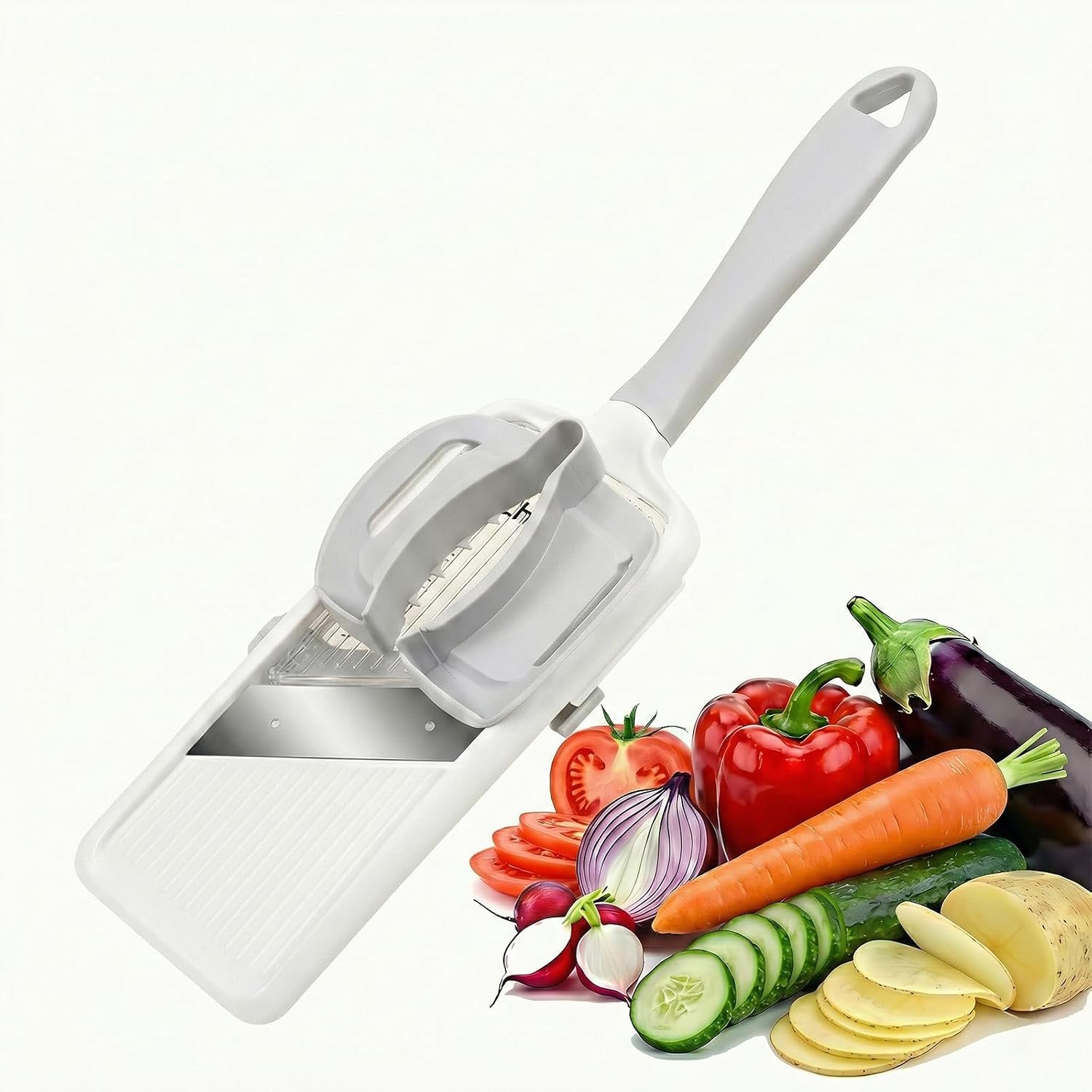
Preparing fresh ingredients can take a surprising amount of time when every vegetable or fruit has to be cut by hand. A sharp kitchen knife remains one of the most versatile preparation tools available, but achieving consistently thin slices can require practice, patience, and careful technique.
A handheld mandoline slicer offers a different approach. Instead of manually controlling every slice with a knife, the ingredient is guided across an integrated cutting blade to create pieces with a more consistent thickness. This can be particularly useful when preparing vegetables for salads, sandwiches, garnishes, gratins, stir-fries, and other recipes where uniform slices are desirable.
The Upgrade Handheld Mandoline Slicer for Kitchen described in this guide is designed with adjustable three-thickness settings, a longer ergonomic grip, and a larger safety handle. The design focuses on controlled handheld slicing while keeping the tool relatively compact and easy to store.
Its intended use is primarily centered on vegetables and fruits, making it a practical addition to a kitchen preparation routine. At the same time, mandoline slicers contain sharp cutting surfaces, so safe handling is essential. The safety features can assist with control, but they do not eliminate the need for careful technique.
This article explains how a handheld mandoline slicer works, what its adjustable thickness settings can offer, how it can be used with different ingredients, what users should consider before choosing one, and how it compares with knives, box graters, and larger mandoline slicers.
What Is a Handheld Mandoline Slicer?
A mandoline slicer is a kitchen preparation tool designed to cut ingredients into slices of relatively consistent thickness.
Traditional mandolines usually consist of a flat platform, a cutting blade, and some type of food holder or hand guard. The ingredient is moved across the blade, producing slices as it travels.
A handheld mandoline follows the same basic principle in a more compact format.
Rather than placing a large slicer on the countertop, the user holds the tool while guiding the ingredient across the cutting surface or blade.
This design can make the tool easier to store and convenient for smaller preparation jobs.
The tradeoff is that handheld operation requires good control. The user needs to maintain a secure grip on the tool and use the appropriate safety technique throughout the slicing process.
Key Features
The product described in this article incorporates several features intended to make handheld slicing more manageable.
Three Adjustable Thickness Settings
One of the main features is the ability to adjust the slicing thickness across three settings.
Thickness can significantly change the way an ingredient behaves in a recipe.
Thin slices may work well for salads, sandwiches, garnishes, and quick-cooking preparations. Medium slices can provide more structure, while thicker slices may be appropriate for roasting or other dishes where the ingredient needs to retain more substance.
Having multiple settings means the same tool can be adapted to different recipes instead of producing only one fixed thickness.
The exact thickness associated with each setting should be confirmed through the manufacturer’s specifications and adjustment markings.
Longer Ergonomic Grip
The slicer is described as having a longer comfort-oriented ergonomic grip.
Handle design matters with handheld kitchen tools because users need to maintain control while applying consistent movement.
A longer grip can provide more room for the hand and may be easier to hold during repetitive slicing.
Ergonomic design does not guarantee that every user will find the handle equally comfortable. Hand size, grip preference, and the quantity of food being prepared can all influence comfort.
Bigger Safety Handle
The product also features a larger safety handle.
A safety handle or food holder is intended to help keep the user’s hand farther away from the cutting blade while the ingredient is being sliced.
This is an important feature for mandoline-style tools because the blade is sharp by design.
However, the safety handle should not be treated as an absolute guarantee against injury. Users should follow the manufacturer’s instructions and maintain careful control throughout the process.
Compact Handheld Format
Unlike a large countertop mandoline, a handheld slicer can occupy relatively little storage space.
This can be convenient for kitchens with limited cabinets or drawers.
It can also be easier to bring out for a small preparation task without setting up a larger appliance or multi-part slicer.
Easy-to-Clean Design
The product is described as easy to clean.
Kitchen slicers can collect small food particles around their blades and structural components, so cleaning is an important part of routine use.
The exact cleaning method should follow the manufacturer’s instructions.
Because the cutting edge is sharp, users should exercise particular care when washing the tool.
Why Consistent Slicing Matters
Uniform slicing is not only an aesthetic concern.
The thickness of a food item can influence cooking time and texture.
If potato slices vary significantly in thickness, thinner pieces may cook faster than thicker ones.
The same principle applies to many vegetables used for roasting, frying, baking, or sautéing.
Consistent slices can therefore help create more predictable results.
For raw preparations such as salads, uniform pieces can also create a more consistent bite.
A mandoline can help achieve this consistency more quickly than manually cutting every piece with a knife.
How It Can Be Used
A handheld mandoline slicer can be used for a broad range of vegetables and fruits.
Slicing Cucumbers
Cucumbers are a common application for mandoline slicers.
Thin cucumber slices can be used in salads, sandwiches, wraps, pickled preparations, and garnishes.
The adjustable thickness settings make it possible to choose between delicate thin slices and thicker pieces.
Because cucumbers contain a significant amount of water, the cutting surface should be cleaned after use.
Preparing Potatoes
Potatoes can be sliced for numerous recipes.
Thin slices may be useful for homemade chips or layered dishes, while thicker slices can work for roasting or other preparations.
When using a mandoline with potatoes, the ingredient should be held securely and moved in a controlled direction.
The final cooking method should determine the appropriate thickness.
Slicing Carrots
Carrots can be difficult to slice consistently with a knife, particularly when preparing large quantities.
A mandoline can create relatively uniform rounds or slices.
These can be added to salads, soups, stir-fries, vegetable trays, or roasted dishes.
Preparing Zucchini
Zucchini can be sliced into thin or medium pieces for grilling, roasting, casseroles, or vegetable dishes.
The adjustable thickness can help match the slices to different recipes.
Slicing Onions
Onions can also be prepared using a mandoline.
Thin onion slices can be useful for salads, sandwiches, burgers, pickled preparations, and cooking.
The blade should be kept clean after use because onion residue can remain around the cutting area.
Slicing Radishes
Radishes are another useful application.
Thin radish slices can be used for salads, sandwiches, tacos, garnishes, and vegetable platters.
The consistent thickness produced by a mandoline can create a uniform presentation.
Preparing Apples
Firm apples can sometimes be sliced using a mandoline, depending on their size and firmness.
Apple slices can be used for salads, snacks, desserts, or baking.
Soft or overly ripe fruit may not slice as cleanly and may be more difficult to control.
Slicing Pears
Firm pears can also be suitable for slicing.
As with apples, the fruit should be stable and firm enough to move safely across the cutting surface.
Preparing Tomatoes
Tomatoes can be sliced for sandwiches, salads, burgers, and other dishes.
Firm tomatoes are generally easier to control than very soft or overripe ones.
Because tomatoes contain substantial moisture, cleaning afterward is important.
Choosing the Right Thickness
The ability to adjust thickness is one of the most useful features of a mandoline.
Different foods and recipes call for different slice dimensions.
Thin Slices
Thin slices can be useful when ingredients need to cook quickly or when a delicate texture is desired.
Examples include:
- Cucumber for salads
- Radish for garnishes
- Onion for sandwiches
- Potato for chips
- Apple for certain desserts
Thin slicing can also make ingredients visually appealing.
Medium Slices
Medium thickness can be useful for everyday cooking.
Vegetables such as zucchini, carrots, potatoes, and onions can be sliced at a medium setting for roasting, sautéing, or casseroles.
Thicker Slices
Thicker cuts can retain more structure.
They may be appropriate for roasting vegetables, preparing substantial sandwich fillings, or creating larger pieces for certain recipes.
The correct thickness ultimately depends on the cooking method and desired texture.
Who It May Be Suitable For
A handheld mandoline slicer can fit several kitchen routines.
Home Cooks
People who regularly prepare fresh vegetables can use a mandoline to speed up repetitive slicing tasks.
Salad Preparation
Anyone who frequently prepares salads may appreciate consistent cucumber, carrot, radish, onion, or other vegetable slices.
Meal Preppers
Meal preparation often involves cutting large quantities of ingredients.
A mandoline can help create uniform pieces for multiple meals.
Small Kitchens
The compact handheld design can be useful where storage space is limited.
It does not require the same countertop footprint as a large food processor or full-size mandoline setup.
Beginners
A mandoline can introduce users to consistent slicing without requiring advanced knife skills.
However, beginners should spend time learning safe handling techniques before attempting to work quickly.
Experienced Cooks
Experienced cooks can also benefit from a mandoline when a recipe requires many uniform slices.
The tool can complement, rather than replace, a chef’s knife.
Important Things to Consider
A mandoline slicer has a sharp blade, so safety should be a central consideration.
The Blade Is Sharp
The cutting edge is designed to slice food efficiently.
That same sharpness creates an injury risk if the user’s fingers come into contact with it.
Always use the provided safety handle or guard according to the manufacturer’s instructions.
Do Not Rush
Speed should not be the primary goal.
Controlled movements are generally preferable to fast, forceful strokes.
As the ingredient becomes smaller, extra caution is needed.
Secure the Ingredient
Ingredients should be positioned securely before slicing.
Round foods can be more difficult to control than flat or stable vegetables.
If an ingredient becomes too small to hold safely with the provided guard, it may be better to stop slicing rather than attempting to cut the final piece by hand against the blade.
Check the Thickness Setting
Make sure the desired setting is properly adjusted before beginning.
Changing the setting while the tool is in use may create unnecessary risk.
Keep Hands Away From the Blade
The safety handle is there for a reason.
Keep fingers away from the cutting edge and do not attempt to guide food directly with bare fingertips.
Clean Carefully
Mandoline blades require special attention during cleaning.
Do not casually reach into the blade area with a sponge.
Follow the manufacturer’s recommended cleaning procedure.
Cleaning a Handheld Mandoline
Cleaning is an important part of using any kitchen slicer.
Food particles can remain around the blade, adjustment mechanism, or frame.
Clean Soon After Use
Food residue is often easier to remove before it dries.
After finishing preparation, clean the slicer according to the manufacturer’s instructions.
Handle the Blade Carefully
Never assume that a blade is harmless simply because the slicer is not being used.
Treat the cutting edge as sharp during washing, drying, and storage.
Pay Attention to Small Areas
Vegetable fibers and small pieces can collect around corners and the cutting opening.
Inspect the tool carefully during cleaning.
Dry Before Storage
Allow the slicer to dry appropriately before putting it away.
This can help maintain a cleaner storage environment.
Handheld Mandoline vs. Chef’s Knife
A chef’s knife is one of the most versatile kitchen tools available.
It can chop, slice, dice, mince, and perform many other tasks.
With practice, a skilled cook can produce highly consistent slices.
The advantage of a mandoline is repeatability.
Once the thickness is adjusted, the tool is designed to produce slices that are broadly similar in size.
The tradeoff is flexibility.
A knife can create many different cuts and shapes, while a mandoline is more specialized.
A kitchen does not necessarily need to choose one or the other.
A knife can handle irregular cuts and small preparation tasks, while a mandoline can handle repetitive slicing.
Handheld Mandoline vs. Box Grater
A box grater is designed primarily for grating and shredding.
Many models also include a slicing surface, but their primary function is different from that of a dedicated mandoline.
A mandoline is generally designed around controlled slicing and adjustable thickness.
A box grater may be more versatile for cheese, vegetables, and shredding tasks.
The appropriate tool depends on the preparation required.
Handheld Mandoline vs. Food Processor
Food processors can perform many preparation tasks, including slicing, shredding, chopping, and mixing.
They can be particularly useful when processing large quantities.
However, they require more components, electricity, setup, and cleanup.
A handheld mandoline is simpler for small slicing tasks.
For one cucumber or a few potatoes, a compact slicer may be more convenient than assembling a food processor.
For large quantities, a food processor may provide greater efficiency.
Handheld Mandoline vs. Large Countertop Mandoline
A full-size countertop mandoline can provide a stable platform and may include additional cutting options.
Its larger size can make it suitable for substantial preparation tasks.
The downside is storage.
A handheld mandoline is more compact and can be easier to store in a drawer or cabinet.
The tradeoff is that handheld operation requires the user to maintain control throughout slicing.
Improving Slicing Consistency
A few simple habits can help users get more consistent results.
Choose Firm Ingredients
Firm vegetables are generally easier to control than soft or overripe ones.
Cucumbers, carrots, potatoes, radishes, and firm apples are examples of ingredients that can work well.
Cut Ingredients to a Manageable Shape
Very large vegetables may be difficult to control.
Cutting them into a suitable size before using the mandoline can improve stability.
Keep the Motion Consistent
Use a steady back-and-forth movement according to the tool’s design.
Avoid sudden changes in direction.
Apply Appropriate Pressure
Excessive force is usually unnecessary.
Let the blade perform the cutting while maintaining control over the ingredient.
Use the Same Setting for a Batch
If a recipe requires uniform slices, prepare the entire batch at the same thickness before changing the adjustment.
Foods That May Be More Challenging
Not every ingredient is equally suitable for a handheld mandoline.
Very soft fruits can collapse or deform under pressure.
Extremely hard foods may require significant force and should only be used if the manufacturer indicates they are appropriate.
Irregularly shaped ingredients can also be difficult to control.
Small ingredients become particularly challenging near the end of the slicing process.
The safest approach is to follow the manufacturer’s recommended food types and use the safety holder throughout the process.
Food Preparation and Meal Planning
A mandoline can be useful beyond individual recipes.
Meal preparation often involves cutting several vegetables in advance.
For example, carrots, cucumbers, onions, and zucchini can be prepared and stored for use throughout the week, subject to appropriate food-storage practices.
Consistent slices can also make portioning and cooking more predictable.
When preparing ingredients in advance, remember that cut produce may have different storage requirements from whole produce.
Use appropriate containers and refrigeration practices for perishable foods.
Presentation and Garnishing
Consistent slices can also improve food presentation.
Thin cucumber or radish slices can be arranged on salads.
Apple or pear slices can be used to decorate desserts or cheese boards.
Vegetable slices can add visual variety to sandwiches and wraps.
The mandoline does not replace culinary creativity, but it can make certain decorative cuts easier to reproduce.
Safe Storage
A mandoline should be stored carefully because its blade remains sharp even when the tool is not being used.
If the product includes a protective cover or storage feature, use it according to the manufacturer’s instructions.
Store the slicer somewhere where children cannot easily access it.
Avoid placing loose sharp tools in a drawer where they can be grabbed accidentally.
If the blade is exposed, position the tool so the cutting edge is protected from unnecessary contact.
Caring for the Blade
A mandoline’s performance depends heavily on the condition of its cutting edge.
Avoid using the blade for ingredients outside its intended purpose.
Do not attempt to sharpen or modify the blade unless the manufacturer specifically provides instructions for doing so.
If the blade becomes damaged, loose, or otherwise unsafe, discontinue use until the issue is addressed appropriately.
Common Mistakes to Avoid
Using Bare Hands Near the Blade
This is one of the most important mistakes to avoid.
Always use the safety holder or guard.
Slicing Too Quickly
Fast movements can reduce control.
A consistent, controlled rhythm is generally preferable.
Continuing With a Tiny Piece
Once the ingredient becomes too small for safe handling, stop.
Do not sacrifice safety simply to use every last piece.
Ignoring the Cleaning Instructions
Sharp blades require careful cleaning.
Follow the manufacturer’s recommendations.
Forcing Hard Ingredients
If an ingredient does not move smoothly through the slicer, do not force it.
Check whether the food is appropriate for the tool and whether the thickness setting is suitable.
Leaving the Tool Loose in a Drawer
A sharp mandoline should be stored deliberately.
Protect the blade and keep the tool away from children.
Frequently Asked Questions
What is a handheld mandoline slicer?
A handheld mandoline slicer is a compact kitchen tool designed to cut vegetables and fruits into relatively uniform slices using an integrated sharp blade.
How many thickness settings does this model have?
The product is described as offering three adjustable slicing thicknesses.
Why are adjustable thickness settings useful?
Different recipes require different slice sizes. Adjustable settings allow users to select a thinner, medium, or thicker cut depending on the food and cooking method.
Can the slicer be used for vegetables?
Yes. Vegetables are one of the primary applications for a mandoline slicer. Common examples include cucumbers, potatoes, carrots, zucchini, onions, and radishes.
Can it be used for fruit?
The product is intended for vegetables and fruits. Firm fruits such as apples and pears may be suitable, while very soft or overripe fruit can be more difficult to control.
Does a mandoline produce perfectly identical slices?
A mandoline is designed to produce relatively consistent slices, but results depend on the ingredient, technique, pressure, and tool settings.
Is the blade sharp?
A mandoline slicer relies on a sharp cutting edge to slice food. Users should treat the blade as a serious cutting hazard and follow the provided safety instructions.
What is the larger safety handle for?
The safety handle is intended to help users maintain control of the food while keeping their fingers farther away from the cutting blade.
Should the safety handle always be used?
Yes. Users should follow the manufacturer’s instructions and use the supplied safety features as intended.
Is the longer ergonomic grip useful?
A longer grip can provide additional hand space and may make the tool more comfortable for some users during repetitive slicing. Comfort varies from person to person.
Can beginners use a handheld mandoline?
Beginners can use a handheld mandoline, but they should first become familiar with the tool and its safety instructions. Controlled movement is more important than speed.
Can a mandoline replace a chef’s knife?
No. A mandoline and chef’s knife serve different purposes. A knife offers much greater flexibility, while a mandoline is particularly useful for repeated, consistent slicing.
Is a handheld mandoline easier to store?
Its compact format can make storage easier than larger countertop mandolines or food processors.
Can it slice potatoes?
Firm potatoes are commonly sliced with mandoline-style tools. The appropriate thickness depends on the intended recipe.
Can it slice cucumbers?
Yes. Cucumbers are a common use for mandoline slicers and can be prepared at different thicknesses.
Can it slice onions?
Yes. Firm onions can be sliced using a mandoline, provided they are securely held and the safety handle is used.
Can it slice tomatoes?
Firm tomatoes can often be sliced with mandoline-style tools, although very soft tomatoes may be more difficult to control.
Can it slice carrots?
Yes. Carrots can be sliced into relatively consistent pieces for salads, soups, roasting, and other dishes.
Can it slice apples?
Firm apples may be suitable for slicing, depending on their size and the manufacturer’s recommendations.
Is the mandoline dishwasher safe?
Dishwasher compatibility should be confirmed through the manufacturer’s instructions. Users should not assume that every mandoline or blade assembly is dishwasher safe.
How should the blade be cleaned?
Clean it according to the manufacturer’s instructions while treating the blade as sharp throughout the process. Avoid placing fingers directly against the cutting edge.
How should the slicer be stored?
Store it in a clean, dry location where the blade is protected and children cannot access it.
What should I do when the vegetable becomes too small?
Stop slicing when the remaining piece can no longer be held safely with the supplied safety mechanism. Do not attempt to finish the last portion with bare fingers near the blade.
Can the slicer be used for large quantities?
It can handle repeated slicing tasks, but the practical quantity depends on the user’s comfort, ingredient type, and preparation routine. A food processor may be more appropriate for very large batches.
What ingredients are difficult to slice with a mandoline?
Very soft, overripe, irregularly shaped, or extremely hard ingredients can be more challenging. Follow the manufacturer’s recommendations for suitable foods.
Why do slice thicknesses matter when cooking?
Thickness affects cooking time, texture, and presentation. Uniform slices can help ingredients cook more evenly.
Is a mandoline useful for meal preparation?
Yes. It can help prepare consistent slices of vegetables and fruits for salads, sandwiches, roasting, cooking, and other meals.
What is the main thing to remember when using a mandoline?
Safety should come before speed. Keep fingers away from the blade, use the safety holder, maintain controlled movements, and stop when an ingredient becomes too small to handle safely.
Conclusion
A handheld mandoline slicer is designed to simplify one of the most repetitive tasks in food preparation: creating relatively uniform slices of vegetables and fruits.
The Upgrade Handheld Mandoline Slicer described in this guide combines three adjustable thickness settings with a longer ergonomic grip and a larger safety handle. Together, these features are intended to make the slicing process more adaptable and controlled while maintaining a compact form that can be convenient for everyday kitchen storage.
The adjustable thickness system is particularly useful because different recipes call for different types of slices. Thin cucumber or radish slices can work well in salads and garnishes, medium vegetable slices can be useful for everyday cooking, and thicker pieces may be suitable for roasting or other preparations.
The tool can also save repetitive knife work when preparing larger quantities of firm vegetables such as potatoes, carrots, zucchini, onions, and cucumbers. Firm fruits such as apples and pears may also be suitable for certain slicing tasks.
However, the most important consideration with any mandoline is safety. The cutting blade is intentionally sharp, and even a tool with a larger safety handle requires careful handling. Users should keep their fingers away from the blade, use the supplied safety mechanism, avoid rushing, and stop when an ingredient becomes too small to handle safely.
Cleaning and storage deserve equal attention. Food particles should be removed after use, the blade should be handled carefully during cleaning, and the slicer should be stored where the sharp cutting edge cannot cause accidental injury.
Compared with a chef’s knife, a handheld mandoline is more specialized but can provide greater consistency for repeated slicing. Compared with a food processor or large countertop mandoline, it can offer a more compact and straightforward solution for smaller preparation tasks. These tools can complement one another rather than serving as direct replacements.
Ultimately, a handheld mandoline can be a practical addition to a kitchen for people who frequently prepare sliced vegetables and fruits and want a convenient way to achieve more consistent thickness. Its value depends on using the appropriate foods, selecting a suitable thickness, maintaining good technique, and treating the blade with the respect required of any sharp kitchen tool.
Leave a Reply