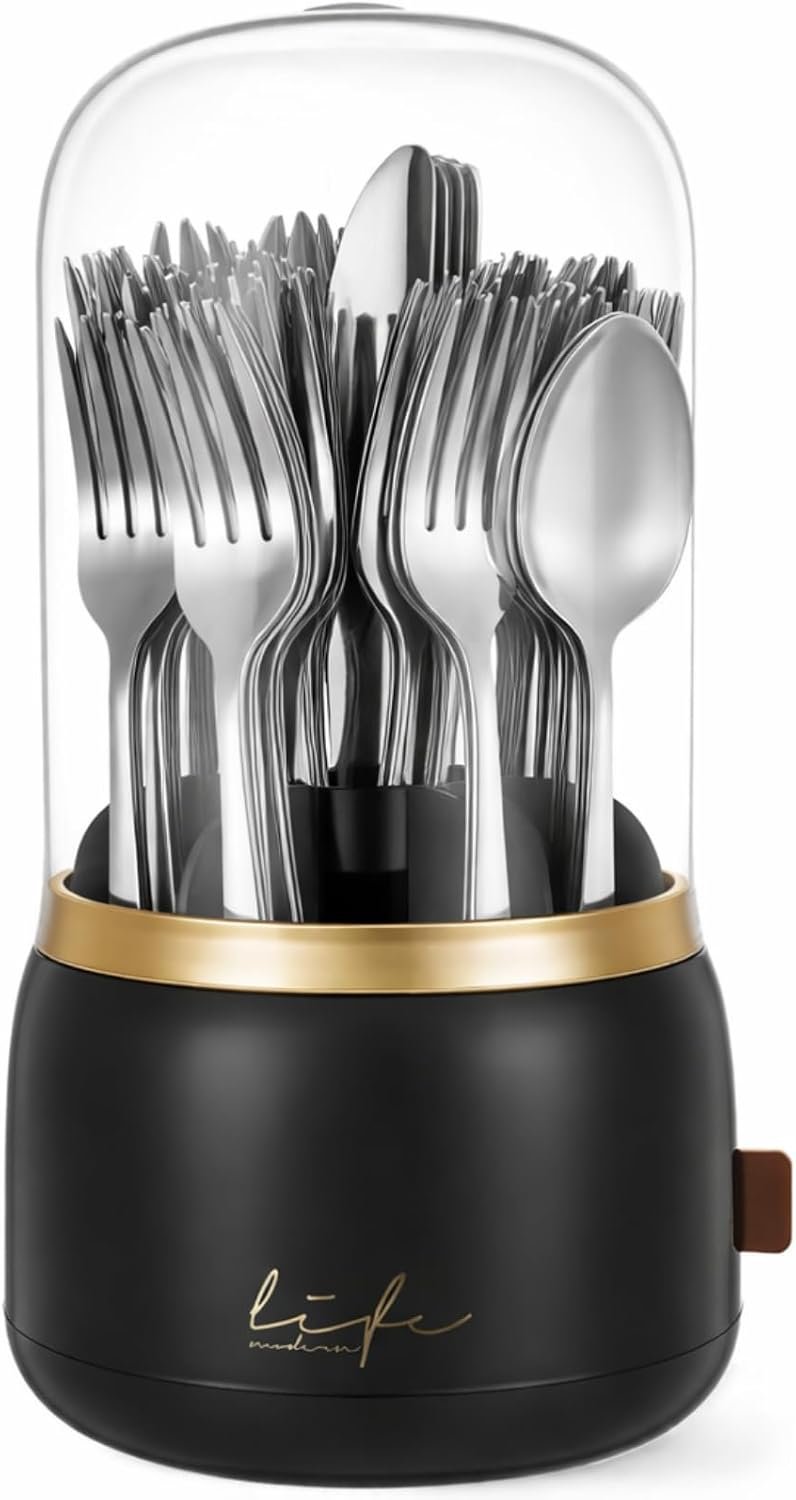
Keeping everyday utensils organized can make a noticeable difference in how a kitchen functions. Forks, spoons, knives, serving utensils, and other frequently used items tend to accumulate around food-preparation areas, especially when there is limited drawer space or when meals are served for several people at once. A countertop silverware organizer offers an alternative by keeping commonly used utensils visible, separated, and easy to reach.
The Silverware Organizer with Lid and 360 Rotation is designed as a countertop utensil holder with seven storage sections. It is intended to accommodate standard silverware and most steak knives measuring up to approximately 8.5 inches, while its rotating design allows access from different directions. A lid is also included, providing an additional option for covering the stored utensils when the organizer is not being actively used.
This type of organizer can be useful in everyday kitchens, dining areas, outdoor gatherings, parties, and other situations where utensils need to remain accessible without taking up an entire drawer. At the same time, countertop storage is not the right solution for every kitchen. Available space, cleaning preferences, utensil sizes, and how often the organizer will be used are all worth considering.
This guide explains how a seven-slot rotating silverware organizer works, what its features mean in practical terms, how it can be used, and what to consider before adding one to a kitchen organization system.
What Is a Countertop Silverware Organizer?
A countertop silverware organizer is a storage container designed to hold utensils outside of a traditional kitchen drawer. Instead of placing forks, knives, and spoons horizontally inside a compartmented drawer, utensils are generally stored upright or at an angle in separate sections.
This arrangement can be particularly convenient for utensils that are used throughout the day. Someone preparing breakfast, setting a dining table, or serving food can reach for the necessary utensil without opening a drawer.
The organizer discussed here uses a seven-slot layout, giving users multiple sections for separating different types of utensils. Depending on how a household organizes its kitchen, the compartments can be assigned to forks, tablespoons, teaspoons, knives, serving utensils, cooking tools, or other frequently used items.
The rotating structure adds another practical element. Rather than requiring someone to reach around the organizer, the holder can be turned so that a particular section is positioned closer to the person using it.
The included lid provides a way to cover the organizer between uses. This can be useful when utensils are being stored on a countertop, dining station, outdoor serving area, or another exposed location.
Key Features of the Silverware Organizer
Understanding the individual features is more useful than simply looking at the organizer as another kitchen container. Each design element addresses a particular storage problem.
Seven Separate Storage Slots
One of the main characteristics of this organizer is its seven-slot configuration.
Separate compartments can make it easier to establish a consistent storage system. For example, a household might dedicate different sections to:
- Dinner forks
- Salad forks
- Spoons
- Teaspoons
- Table knives
- Steak knives
- Serving utensils
There is no requirement to use the compartments in this exact way. The layout can be adapted depending on the types of utensils a household uses most frequently.
Having multiple sections can also reduce the tendency for utensils to become mixed together. Instead of reaching into one large container filled with everything, users can identify the general category of utensil they need.
For kitchens where multiple people regularly use the same countertop area, this separation can also make putting utensils away more straightforward.
360-Degree Rotation
The rotating design is another notable feature.
A stationary utensil holder can require users to walk around it or reach across the countertop to find a particular section. A rotating organizer provides a different approach: the container can be turned so the desired compartment comes into a more convenient position.
This can be especially helpful when the organizer is placed in the middle of a kitchen island, dining table, buffet station, or shared preparation area.
The rotation may also make the organizer easier to use when several people are accessing it from different directions. Instead of everyone approaching the same side, the holder can be repositioned as needed.
As with any rotating kitchen accessory, the exact movement and stability will depend on how the organizer is designed and how it is placed on the countertop. A level, uncluttered surface is generally preferable.
Included Lid
A lid gives the organizer another storage option.
Open countertop utensil holders provide immediate access, but they also leave the stored items exposed. A cover can be useful when the utensils are being stored for a longer period or when the organizer is positioned in an area where it may collect dust or kitchen debris.
The lid can also be practical during events. If utensils are prepared in advance for a party or gathering, covering the organizer until it is needed can provide an additional layer between the stored utensils and the surrounding environment.
The lid does not eliminate the need for normal utensil washing and hygienic food-handling practices. Clean, dry utensils should be placed into storage, and the organizer itself should be maintained according to the manufacturer’s care instructions.
Capacity for Standard Utensils
The organizer is designed around standard kitchen silverware and is described as accommodating most steak knives up to approximately 8.5 inches.
This measurement is important because kitchen utensils vary considerably in length. A container that works well for teaspoons and dinner forks may not accommodate longer knives or oversized serving tools.
Before using the organizer for particularly large utensils, it is sensible to compare their dimensions with the available compartment space.
The stated knife capacity should also be understood as a general size guideline rather than a guarantee that every knife measuring below the listed length will fit comfortably. Handle shape, blade width, and the internal dimensions of a particular compartment can affect how an item sits inside the holder.
Countertop Design
Unlike drawer organizers, this style is intended to remain visible on a countertop or other flat surface.
That makes it useful in kitchens where drawer space is limited. It can also serve as a dedicated utensil station when several people need access to silverware during meals.
The black finish gives the organizer a relatively neutral appearance that can work with many kitchen color schemes. However, the visual fit will naturally depend on the rest of the kitchen’s décor and countertop materials.
Why Countertop Utensil Storage Can Be Useful
Drawer storage is common, but it is not always the most convenient solution.
Some kitchens have shallow drawers, limited drawer capacity, or drawer layouts that are already occupied by cooking tools. Others may have an open kitchen design where a countertop utensil station is more practical.
Countertop storage can provide several organizational advantages.
First, frequently used utensils remain visible. This can reduce the need to repeatedly open and close drawers during meal preparation.
Second, separate compartments make categorization easier. Instead of sorting through a mixed collection of utensils, users can establish dedicated areas.
Third, a countertop organizer can be moved to a different location when needed. During a family meal, for example, it can be positioned closer to the dining area. For a party, it can become part of a buffet setup.
The tradeoff is that countertop storage requires physical space. A holder that is convenient on a large kitchen island may feel intrusive on a small counter.
How It Can Be Used
A rotating seven-slot organizer can serve several purposes beyond simply holding everyday silverware.
Everyday Kitchen Organization
For daily use, the simplest arrangement is to assign each compartment to a particular utensil category.
Forks can occupy one section, spoons another, and knives another. Additional compartments can be reserved for less frequently used silverware or serving tools.
This approach creates a predictable routine. After washing dishes, utensils can be returned to their designated sections instead of being placed wherever there is available space.
Over time, consistent organization can make the countertop area easier to maintain.
Family Dining
A countertop organizer can also function as a shared silverware station.
Rather than placing every type of utensil directly on the dining table, the organizer can remain in a convenient location where family members can take what they need.
The rotating feature can be particularly useful when the organizer is positioned where people approach it from different directions.
This arrangement can also be useful for casual meals where everyone serves themselves.
Parties and Gatherings
Large meals often create a temporary need for additional utensil organization.
A seven-section holder can be prepared before guests arrive and placed near a buffet table, serving area, kitchen island, or dining space.
Different compartments can be assigned to different types of utensils. For example, forks, spoons, dinner knives, and specialty utensils can each have their own location.
The lid can be used while the organizer is waiting to be put into service.
For outdoor events, however, users should consider environmental conditions such as wind, dust, moisture, and uneven surfaces. A countertop organizer is generally most practical when placed on a stable and suitable surface.
Outdoor Dining
The organizer may also be useful for patios, outdoor kitchens, picnics with a suitable table, or casual gatherings.
Its compartment-based design can reduce the need for several separate cups or containers holding different types of silverware.
If it is used outdoors, it is still important to protect clean utensils from dirt and other contaminants. The included cover may be useful when the utensils are prepared ahead of time.
After outdoor use, the organizer should be cleaned appropriately before being returned to regular kitchen storage.
Buffet Stations
Buffet-style meals often benefit from clearly separated utensils.
A rotating holder can be placed beside serving dishes so guests can access forks, spoons, and knives without searching through a single container.
The seven compartments provide flexibility for larger gatherings where several utensil categories are needed.
The organizer can also be repositioned as guests move around the serving area.
Specialty Utensils
Although designed around silverware, some compartments may be useful for other small kitchen tools, provided their dimensions and shape are compatible.
Examples could include small serving spoons, dessert utensils, reusable straws, or other compact items.
However, sharp or unusually shaped objects should be stored carefully. The organizer should not be overloaded with items that could make it unstable or difficult to use.
Organizing the Seven Compartments Efficiently
The number of compartments provides flexibility, but good organization still depends on how they are assigned.
One approach is to organize by frequency of use.
The most frequently used utensils can occupy the sections that are easiest to access. Less frequently used items can be placed in the remaining compartments.
Another approach is to organize by meal type.
For example, a household might keep everyday forks and spoons in several sections while reserving another compartment for serving utensils.
A third option is to organize according to household habits. Families that use many knives may benefit from dedicating additional space to knives, while households that frequently serve salads or desserts may prefer compartments for those utensils.
There is no universally correct configuration. The most useful arrangement is the one that matches the way the kitchen is actually used.
Who It May Be Suitable For
A countertop silverware organizer may be useful for several types of households.
Kitchens With Limited Drawer Space
If drawers are already filled with utensils, cooking tools, towels, or other equipment, moving frequently used silverware to the countertop can free up some internal storage.
Busy Family Kitchens
Families often use the same forks, spoons, and knives repeatedly throughout the day. Keeping these items accessible can simplify routine meal preparation and table setting.
People Who Host Gatherings
Anyone who regularly prepares meals for groups may appreciate having a dedicated utensil station that can be moved to a buffet or dining area.
Shared Living Spaces
In shared kitchens, clear organization can reduce confusion about where common utensils belong.
People Who Prefer Visible Organization
Some users simply prefer to see frequently used items rather than opening drawers to locate them. A compartmentalized countertop holder fits that organizational style.
Small Food-Service or Hosting Areas
The organizer can also be considered for informal serving stations where utensils need to be grouped together without taking up a large amount of table space.
Important Things to Consider Before Using One
A countertop organizer can be practical, but several factors should be considered.
Available Counter Space
The most obvious consideration is where the organizer will go.
Measure the intended area before placing it on a crowded countertop. Leave enough surrounding space to access the compartments comfortably and rotate the holder without hitting nearby appliances, containers, or walls.
Utensil Dimensions
Standard forks and spoons generally have relatively predictable dimensions, but knives and serving utensils can vary significantly.
If you intend to store longer steak knives, compare their dimensions with the organizer’s stated capacity.
Oversized utensils may not sit properly even if they appear close to the stated maximum length.
Cleaning Requirements
Any container used to store food-contact utensils should be kept clean.
Before cleaning the organizer, check the manufacturer’s instructions for the appropriate method. Different materials and construction types may have different care requirements.
Avoid assuming that an organizer is dishwasher-safe unless the manufacturer specifically indicates it.
Stability
A rotating organizer should be placed on a level surface.
Avoid placing it where it can easily be knocked over, particularly if it is filled with heavy metal utensils.
The way utensils are distributed can also affect balance. Keeping very heavy items concentrated in one section may produce a different balance than distributing them more evenly.
Open Versus Covered Storage
The included lid makes covered storage possible, but users should decide whether they prefer to keep it on or off during everyday use.
For frequent access, an open configuration may be more convenient. For periods of storage, a cover may be preferable.
Cleaning Before Storage
Only clean, dry utensils should be placed into a storage container.
Putting wet silverware into an enclosed holder can create an environment where moisture remains trapped. Allow utensils to dry properly before storing them.
Cleaning and Maintenance
Kitchen organizers are often overlooked when cleaning routines are established. Yet the organizer itself can come into contact with utensils, hands, food particles, and kitchen dust.
A simple maintenance routine can help keep it in good condition.
Start by removing all utensils from the compartments. Emptying the holder makes it easier to see whether crumbs or other debris have accumulated.
Clean the surfaces using the method recommended by the manufacturer. Pay particular attention to corners, compartment edges, and areas around the rotating mechanism.
If the design includes moving components, avoid forcing them if they become difficult to rotate. Check for debris or objects that may be interfering with movement.
After cleaning, allow the organizer to dry appropriately before returning utensils to it.
Regular cleaning frequency will depend on how often the organizer is used and where it is located.
An organizer used every day in a busy kitchen may require more frequent cleaning than one used occasionally for special gatherings.
Countertop Organizer vs. Drawer Organizer
Drawer organizers and countertop holders solve similar problems through different approaches.
A drawer organizer keeps utensils hidden from view and preserves a clean countertop appearance. It can be useful for people who prefer minimal visible storage.
The disadvantage is accessibility. Users need to open the drawer whenever they need a utensil, and drawer space may be limited.
A countertop organizer does the opposite. It uses visible surface space but provides immediate access.
The choice therefore depends on kitchen layout and personal organization preferences.
Countertop Organizer vs. Traditional Utensil Cup
A basic utensil cup is one of the simplest countertop storage solutions. It usually provides one large compartment where utensils stand together.
This approach can be inexpensive and straightforward, but separating different utensil types can be more difficult.
A seven-slot organizer introduces dedicated sections, making categorization easier.
The tradeoff is that a compartmentalized holder may occupy more physical space than a simple cup.
For someone who regularly mixes forks, spoons, and knives together, the additional compartments may offer a more structured arrangement.
Countertop Organizer vs. Large Utensil Caddy
A larger utensil caddy may provide greater capacity, especially for serving tools and cooking utensils.
However, greater capacity can also mean a larger footprint.
A seven-slot rotating organizer occupies a different part of the organizational spectrum. It provides multiple dedicated areas while remaining focused on everyday silverware and similarly sized utensils.
The appropriate option depends on whether the priority is maximum capacity or structured access to a defined collection of utensils.
Practical Tips for Getting More From a Seven-Slot Organizer
A few simple habits can make countertop storage more effective.
Create Permanent Categories
Try to keep each compartment associated with a specific category rather than changing the arrangement every day.
Consistency makes it easier for everyone in the household to return utensils to the correct location.
Keep Frequently Used Items Accessible
Place everyday forks, spoons, and knives in convenient sections.
Less frequently used utensils can occupy the remaining compartments.
Avoid Overfilling
A compartment packed too tightly can make individual utensils difficult to remove.
It can also make returning utensils more frustrating and may affect the overall balance of the holder.
Keep Sharp Items Organized
Knives should be handled carefully when being placed into or removed from any countertop utensil holder.
Avoid reaching blindly into a compartment containing sharp objects.
Use the Lid Strategically
The lid can be useful when the organizer is not being used or when clean utensils are being prepared for an upcoming gathering.
For everyday use, it can be removed when quick access is more important.
Common Mistakes to Avoid
Even a simple organizational tool can become less effective when used incorrectly.
One common mistake is placing the organizer on a countertop that is too crowded. If there is not enough space to rotate it or access the compartments, the rotating function becomes less useful.
Another mistake is storing utensils that are too large. Check dimensions before putting unusually long knives or oversized serving tools into the organizer.
Overloading is another issue. A holder works best when the compartments remain easy to access.
Users should also avoid storing dirty or damp utensils inside the organizer. Proper washing and drying should happen first.
Finally, don’t assume that every part of the organizer can be washed in the same way. Manufacturer care instructions should take priority.
Frequently Asked Questions
How many compartments does this silverware organizer have?
The organizer is designed with seven separate slots for organizing silverware and other compatible utensils.
Can it hold steak knives?
It is described as accommodating most steak knives up to approximately 8.5 inches. Actual fit can vary depending on the dimensions and shape of individual knives.
Does the organizer rotate?
Yes. Its design incorporates 360-degree rotation, allowing different compartments to be brought toward the user.
Is the rotation useful on a kitchen island?
It can be particularly practical on an island or central countertop because people may approach the organizer from different directions.
Does it come with a lid?
Yes. The product is designed with a lid that can be used to cover the organizer when appropriate.
Can it be used for parties?
Yes. Its divided layout can work as a dedicated silverware station for parties, buffets, family gatherings, and other meals involving multiple people.
Can it be used outdoors?
It can potentially be used on a suitable outdoor table or serving area. When used outdoors, clean utensils should be protected from dust, dirt, moisture, and other environmental factors.
Can cooking utensils be stored in it?
Some smaller cooking or serving utensils may fit, but compatibility depends on their dimensions. It is primarily intended for standard silverware and compatible utensils.
Is it suitable for small kitchens?
It may be useful where drawer space is limited, but it still requires countertop space. Measure the available area before deciding where to place it.
Can I store wet utensils in it?
It is preferable to allow utensils to dry properly before storing them in an enclosed organizer.
How should the organizer be cleaned?
Follow the manufacturer’s care instructions. Remove the utensils first and clean the organizer thoroughly, paying attention to compartments and moving areas.
Is it dishwasher-safe?
Do not assume dishwasher compatibility unless it is specifically stated in the manufacturer’s instructions.
Can the compartments be rearranged?
The product is described as having seven slots, but users should not assume that the internal layout can be customized unless the manufacturer specifically indicates that feature.
Will all steak knives under 8.5 inches fit?
Not necessarily. Length is only one factor. Handle thickness, blade shape, and compartment dimensions can influence fit.
Is a rotating organizer better than a drawer organizer?
Neither is universally better. A rotating countertop organizer prioritizes visibility and accessibility, while a drawer organizer keeps utensils out of sight and preserves counter space.
Does the lid need to remain attached?
The lid can be used according to the user’s storage needs. Whether it is kept on during everyday use depends on how frequently the utensils are accessed.
Can it hold serving spoons?
If the serving spoons fit within the compartment dimensions, they may be stored there. Oversized serving utensils may require a larger caddy.
Is it useful for families?
It can be useful for families that frequently use shared utensils and prefer having commonly used silverware accessible on the countertop.
Can it help with table setting?
Yes. Keeping forks, spoons, and knives in organized sections can make it easier to collect the necessary utensils when setting a table.
Does the rotating design require electricity?
No. A manual rotating mechanism does not require an electrical connection.
What is the main advantage of separate compartments?
Separate compartments make it easier to group utensils by type, reducing the need to sort through a mixed container.
Where should it be placed?
A level, stable countertop, island, dining table, or suitable serving surface is generally appropriate. Choose a location with enough surrounding clearance for comfortable access.
Final Thoughts
A countertop silverware organizer can provide a practical alternative to traditional drawer storage. The seven-slot layout creates dedicated areas for different utensil categories, while the rotating design makes those sections accessible from different directions. The included lid adds another storage option for times when the utensils are not being actively used.
For everyday kitchens, the organizer can help establish a consistent place for forks, spoons, knives, and other compatible utensils. During parties and gatherings, it can become a convenient silverware station near a buffet or dining area. It can also be useful in kitchens where drawer space is limited or where frequently used utensils are better kept within easy reach.
At the same time, it is important to consider countertop space, utensil dimensions, cleaning requirements, and storage habits. A countertop holder will not replace every type of kitchen storage, and people who prefer completely clear countertops may still favor drawer-based organization.
The most useful way to think about this type of product is as a dedicated access point for frequently used utensils. When its compartments are organized according to the household’s needs and maintained properly, it can make everyday kitchen routines more structured without requiring a complicated storage system.
If you are considering this type of countertop organization,
Leave a Reply