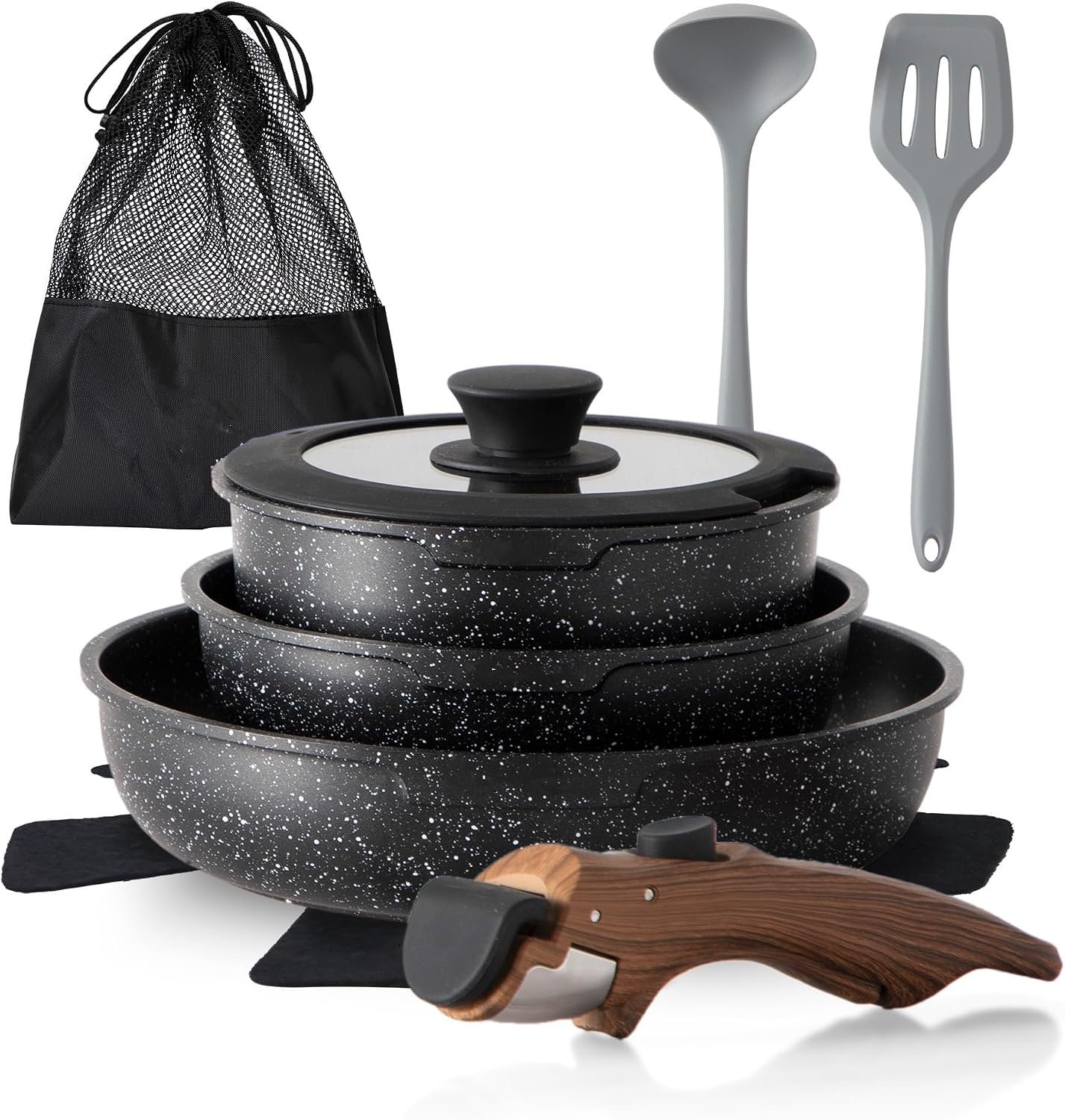
Choosing cookware is about more than finding pots and pans that can prepare a meal. In a modern kitchen, storage space, cleaning, cooking flexibility, and the way different pieces work together can be just as important as the cooking surface itself.
Traditional cookware usually has permanently attached handles. That familiar design works well for many kitchens, but long handles can make cabinets crowded, complicate stacking, and take up valuable space on small countertops. Removable-handle cookware takes a different approach. The handles can be attached when the cookware is being moved or used and detached when the pieces need to be stored, depending on the manufacturer’s instructions.
The Removable Handle Pots and Pans 10-Piece Cookware Set discussed in this guide is designed around this space-conscious concept. The set combines multiple cookware pieces with a nonstick cooking surface and detachable handles. The product is also described as suitable for induction cooking, making compatibility an important consideration for households using modern induction cooktops.
A cookware system like this can be particularly interesting for apartments, compact kitchens, RVs, vacation homes, or anyone who wants to organize several cookware pieces without dealing with a collection of permanently extended handles.
At the same time, removable-handle cookware has its own considerations. A detachable handle is a mechanical component that needs to be attached correctly before lifting cookware. Nonstick surfaces also require appropriate care, including sensible heat management, compatible utensils, and suitable cleaning methods.
This article explores the practical features of removable-handle pots and pans, explains how a 10-piece nonstick cookware set can fit into everyday cooking, compares it with other cookware categories, and covers the important factors to consider before incorporating this type of cookware into a kitchen.
What Is Removable-Handle Cookware?
Removable-handle cookware is designed so that the handle can be detached from the main body of a pot or pan.
With traditional cookware, the handle remains permanently attached. This makes the pan immediately ready to lift and maneuver, but the handle also remains in place when the pan is being stored.
A removable-handle design separates these two functions.
When cooking, the handle can be attached according to the manufacturer’s instructions. After cooking, it can potentially be removed, allowing the cookware body to occupy less space in a cabinet or storage area.
This design can be particularly useful when several pans need to be stacked or nested. Without a long handle extending from every piece, cookware can often be arranged more compactly.
The concept is not necessarily about changing the fundamental way food is cooked. A frying pan with a detachable handle can still be used for many of the same meals as a conventional frying pan. The main difference is the way the cookware can be handled and stored.
Key Features
Several characteristics are particularly relevant when considering a 10-piece removable-handle cookware set.
10-Piece Configuration
The set is described as a 10-piece cookware collection.
A multi-piece set can provide several cookware options within one coordinated system, making it possible to select different sizes for different cooking tasks.
The exact pieces included in a set should always be confirmed through the current product listing and manufacturer information. Depending on the configuration, cookware sets can contain different combinations of frying pans, saucepans, pots, lids, handles, or other components.
Having multiple pieces can be useful for households that prepare several parts of a meal at once.
For example, a larger vessel may be used for pasta or soup, while a smaller pan prepares vegetables or a protein. Another piece may be reserved for breakfast foods or sauces.
The usefulness of a multi-piece collection therefore depends not just on the number of pieces but on whether the sizes and shapes match the cooking habits of the household.
Removable Handles
The detachable handle is the defining feature of this cookware design.
A properly attached handle provides the leverage needed to lift, move, and control the cookware.
Once the cookware is no longer being moved, the handle can be detached according to the manufacturer’s instructions. This can make the cookware easier to stack and store.
The handle mechanism should be treated as an important safety component. Before lifting a pot or pan containing food, users should confirm that the handle is fully and securely attached.
It is also useful to become familiar with the attachment mechanism before cooking with hot food. Practicing with empty, cool cookware can make the process easier to understand.
Nonstick Cooking Surface
The cookware is described as nonstick.
Nonstick cookware is designed to reduce the tendency of food to adhere to the cooking surface. This characteristic can be useful when preparing eggs, pancakes, delicate fish, vegetables, and many other foods.
Reduced sticking can also simplify cleanup because food residue may be less firmly attached to the pan.
However, nonstick cookware still requires appropriate care. Excessive heat, sharp utensils, abrasive cleaning materials, and careless storage can damage some nonstick surfaces.
The specific care instructions provided for the cookware should always take priority over general advice.
Induction Compatibility
The product is described as compatible with induction cooking.
Induction cooktops use magnetic energy to heat compatible cookware rather than relying on an exposed flame or a conventional heated electric element.
For households with induction cooktops, cookware compatibility is essential.
Although the product is described as induction compatible, users should still review the manufacturer’s specifications and instructions for proper use. Different induction cooktops can also have different requirements concerning cookware size and placement.
Space-Conscious Storage
The ability to remove the handles can make storage more efficient.
Traditional pans can be difficult to organize because their handles extend outward. They may prevent smaller pans from nesting properly or take up neighboring cabinet space.
With the handles removed, the cookware bodies can potentially be arranged more closely together.
This is especially useful where storage space is limited.
Versatile Everyday Design
A cookware collection containing multiple pieces can support a broad range of everyday meals.
The nonstick surface is suitable for many common cooking applications, while the detachable handle can make storage more convenient.
The actual range of uses depends on the specifications of each piece and the cooking appliances available in the kitchen.
Why Removable Handles Can Matter in a Kitchen
The size of a cookware collection is only part of the storage equation.
The shape of each piece matters as well.
A frying pan may have a cooking surface that fits comfortably inside a cabinet, but its long handle can make the overall footprint considerably larger.
If several pans are stored together, the handles can overlap or prevent efficient nesting.
Removing the handles changes the geometry of the cookware.
More Compact Cabinets
Without handles extending sideways, pans can often be arranged more closely.
This can help maximize cabinet space.
The exact amount of space saved depends on the shape and dimensions of the cookware and the way it is stored.
Easier Nesting
Nesting smaller cookware inside larger pieces is a common way to organize a kitchen.
Detachable handles can make nesting more convenient because they do not need to be positioned around every pan.
However, nesting should be done carefully with nonstick cookware. Direct contact between surfaces can cause scratches if the pans move against one another.
Less Countertop Interference
Long handles can extend into areas used for food preparation.
On a crowded countertop, this can become inconvenient.
A removable handle allows the cookware to be stored or positioned differently when it is not actively being moved.
Useful for Compact Living
Small apartments and other compact living spaces often require kitchen equipment to perform multiple functions without consuming excessive storage space.
A removable-handle cookware system addresses the storage side of this problem while still providing multiple cooking vessels.
How It Can Be Used
A 10-piece cookware set can become part of many different meal-preparation routines.
Cooking Eggs and Breakfast Foods
A nonstick frying pan can be useful for eggs, omelets, pancakes, and similar foods.
These foods can sometimes stick to conventional cooking surfaces, particularly when temperature and cooking fat are not managed appropriately.
A nonstick surface is designed to reduce that problem.
For best care, use suitable utensils and avoid excessive heat.
Sautéing Vegetables
Vegetables can be prepared in an appropriately sized frying or sauté pan.
Onions, peppers, mushrooms, zucchini, spinach, broccoli, and many other ingredients can be sautéed individually or combined with other components of a meal.
A nonstick surface can make cleanup more straightforward when sauces or small amounts of cooking oil are involved.
Preparing Meat
Different cookware sizes can accommodate different portions of meat.
Ground meat, chicken pieces, sausages, fish, and smaller cuts can be prepared in suitable pans.
The pan should not be unnecessarily overcrowded because the amount of food in relation to the cooking surface can influence cooking and browning.
The appropriate cooking temperature also depends on the recipe and the cookware’s limitations.
Making Sauces
Smaller cookware can be useful for sauces, gravies, reheating, and other liquid-based recipes.
A nonstick surface can make it easier to clean away residue after cooking.
However, cooks should avoid using sharp utensils to scrape stuck ingredients from a coated surface.
Cooking Pasta
A larger pot can be used for pasta and other foods requiring a larger cooking vessel.
The cookware should not be filled beyond its recommended capacity.
When handling hot liquids, the removable handle should be securely attached before the cookware is moved.
Preparing Rice and Grains
Rice, quinoa, couscous, and other grains can be prepared in appropriately sized cookware.
The correct vessel depends on the quantity and recipe.
A set containing multiple sizes makes it possible to select cookware based on portion size rather than using the same large pot for every task.
One-Pan Meals
One-pan meals can simplify preparation and cleanup.
Vegetables, proteins, grains, and sauces can sometimes be cooked together in one suitable vessel.
A larger nonstick pan can be useful for these recipes when its capacity is appropriate.
Cooking With a Nonstick Surface
Nonstick cookware is often chosen for convenience, but good habits can help preserve the cooking surface.
Use Moderate Heat When Appropriate
High heat is not necessary for every cooking task.
Many everyday foods can be prepared effectively at low or moderate temperatures.
Users should follow the manufacturer’s recommendations for maximum heat and appropriate stovetop settings.
Avoid prolonged heating of an empty nonstick pan unless specifically permitted.
Choose Suitable Utensils
Utensils can have a direct effect on the condition of a nonstick surface.
Wooden, silicone, or other cookware-safe utensils are often appropriate choices.
Metal utensils can scratch some nonstick coatings, so they should not be used unless the manufacturer specifically indicates that they are compatible.
Avoid Abrasive Cleaning
Abrasive scrubbers and aggressive cleaning techniques can damage some coated surfaces.
Gentle cleaning methods are generally more suitable.
The manufacturer’s instructions should be followed for the specific cookware.
Do Not Treat Nonstick as Indestructible
A nonstick surface is designed for a particular type of use.
It is not immune to scratches, overheating, or wear.
Using the cookware thoughtfully can help preserve its condition.
Using Removable Handles Safely
A detachable handle creates an additional step that users should understand before cooking.
Check the Connection
Before lifting cookware, confirm that the handle is properly attached.
Do not rely solely on visual appearance. Follow the intended locking or attachment procedure.
Consider the Weight
An empty pan and a full pan place different demands on the handle.
A pot filled with water, soup, or food can be considerably heavier than the same vessel when empty.
Move loaded cookware carefully.
Attach Before Moving
If the cookware needs to be lifted or repositioned, the handle should be properly attached before doing so.
Do not attempt to improvise a grip on hot cookware simply because the detachable handle is not connected.
Remove Only When Appropriate
If the handle is designed to be removed during certain cooking or storage situations, follow the manufacturer’s instructions.
Never remove a handle in a way that could cause hot food, oil, or liquid to spill.
Store the Handle Properly
The handle is a separate component when detached, so it needs its own storage location.
Keep it somewhere clean, dry, and easy to access.
A cookware set becomes much easier to use when the handle can be found immediately when needed.
Who It May Be Suitable For
A removable-handle cookware set can be relevant to several different kitchen environments.
People With Limited Cabinet Space
This is one of the most obvious applications.
Small cabinets can become crowded quickly when conventional pans with long handles are stacked together.
A removable-handle design can reduce the footprint of the cookware during storage.
Apartment Kitchens
Apartment kitchens often have less cabinet and countertop space than larger homes.
A multi-piece set that can be stored compactly may help make better use of the available area.
RV Kitchens
RV kitchens require particularly careful organization.
Cabinets are often smaller, and cookware needs to be stored securely when the vehicle is moving.
Removable handles can help reduce the space required by cookware bodies, although every item should still be secured properly during travel.
Students and First-Time Kitchen Owners
A multi-piece set can provide a starting collection for someone setting up a kitchen.
Instead of purchasing each pot and pan separately, a coordinated collection can cover several common cooking tasks.
Small Households
People cooking for one or two people may not need very large cookware for every meal.
A set with multiple sizes can allow users to select a more appropriate vessel for smaller portions.
Home Cooks Who Value Organization
Some kitchens benefit greatly from a structured storage system.
Removable handles can help reduce visual and physical clutter in cabinets.
Important Things to Consider
Before using or choosing removable-handle cookware, there are several factors worth examining.
Confirm the Exact Set Contents
A “10-piece set” is not enough information to determine exactly what cookware is included.
The product listing should be checked for the current configuration.
Understanding the included pieces makes it easier to determine whether the set matches the household’s cooking needs.
Check Cooktop Compatibility
Although this product is described as induction compatible, households should verify compatibility with their specific cooktop.
If the kitchen also uses gas or electric cooking surfaces, confirm whether those surfaces are supported as well.
Understand Oven Compatibility
Users should not assume that cookware with removable handles is automatically suitable for oven use.
Oven compatibility depends on the materials and design.
If the product instructions permit oven use, check the maximum temperature and determine whether the handle or lid needs to be removed.
Check Dishwasher Instructions
Dishwasher compatibility varies between cookware products.
If dishwasher use is supported, follow the manufacturer’s recommendations.
Some households may still prefer hand washing nonstick cookware because it allows more control over how the cooking surface is handled.
Consider Handle Storage
The detachable handle saves space on the cookware, but it still needs somewhere to go.
A drawer, cabinet compartment, or dedicated kitchen organizer can help keep the handle accessible.
Protect the Cooking Surface
When storing multiple pieces together, avoid unnecessary friction between nonstick surfaces.
If the pieces are designed to nest, handle them carefully.
Appropriate separators can be considered where necessary.
Consider the Size of Your Cooking Area
A cookware set can contain several pieces, but not every size will necessarily be ideal for every stovetop burner or induction cooking zone.
Select cookware according to the cooking surface and quantity of food being prepared.
Removable-Handle Cookware vs. Fixed-Handle Cookware
Traditional fixed-handle cookware has one major advantage: simplicity.
The handle is permanently attached and does not require any additional attachment or removal.
For many cooks, this straightforward design is entirely adequate.
The drawback appears primarily during storage.
Long handles can occupy considerable cabinet space and interfere with nesting.
Removable-handle cookware introduces a different tradeoff.
The handle can be detached to create a more compact storage arrangement, but the user must operate the attachment mechanism correctly.
For a large kitchen with plenty of storage space, fixed handles may be perfectly practical.
For a compact kitchen, the storage advantage of removable handles may be more meaningful.
Removable-Handle Cookware vs. Stackable Cookware
Some cookware manufacturers design traditional pots and pans to stack efficiently without detachable handles.
These sets can provide good storage efficiency while keeping the handle permanently available.
This is convenient because there are fewer separate components to manage.
However, fixed handles still occupy space.
Removable-handle cookware can potentially make the storage arrangement even more compact.
The decision comes down to priorities.
If simplicity is the main goal, fixed handles can be appealing.
If storage flexibility is more important, detachable handles can offer an alternative.
Nonstick Cookware vs. Stainless Steel
Stainless steel cookware is widely used for its durability and versatility.
It can handle a broad range of cooking techniques and is often suitable for higher-temperature applications.
However, food can stick to stainless steel when cooking techniques are not properly controlled.
Nonstick cookware is designed to reduce food adhesion.
This can make it particularly convenient for eggs, pancakes, fish, and other delicate foods.
The tradeoff is that coated surfaces require more attention to utensils, heat, cleaning, and storage.
There is no requirement for a kitchen to use only one cookware category. Many households use nonstick cookware for some meals and stainless steel for others.
Nonstick Cookware vs. Cast Iron
Cast iron cookware is valued for its heat retention and ability to handle many cooking applications.
It can be useful for searing, baking, and other techniques where high heat and substantial thermal mass are desirable.
Its weight is one consideration.
Cast iron is generally heavier than many nonstick cookware pieces, and it also requires specific maintenance depending on the type and finish.
Nonstick cookware is often more convenient for foods where easy release is important.
The two categories serve different purposes, and choosing between them depends on the cooking tasks a household performs most frequently.
Nonstick Cookware vs. Ceramic Cookware
Ceramic cookware can refer to several different constructions, so it is important to distinguish ceramic nonstick coatings from solid ceramic cookware.
Nonstick cookware is designed around food release and convenient everyday cooking.
Ceramic cookware can have different heat and maintenance characteristics depending on its construction.
Rather than judging cookware solely by material labels, users should examine the actual specifications, care instructions, and intended applications.
Using the Set in a Small Kitchen
Small kitchens reward thoughtful organization.
A removable-handle cookware set can be organized by placing larger pans at the bottom of a cabinet and nesting smaller compatible pieces inside them.
The handles can be stored separately.
Lids can be arranged vertically if cabinet space allows.
Another approach is to dedicate one cabinet section to cookware bodies and another to handles and lids.
The goal is to make every component easy to find.
If cookware is difficult to retrieve, the theoretical storage advantage becomes less useful in everyday life.
Using the Set in an RV
RV cooking requires a little additional planning.
The cookware should be stored securely whenever the vehicle is moving.
Pots, pans, handles, and lids should not be allowed to shift freely inside cabinets.
The removable-handle design can make cookware easier to organize, but it does not eliminate the need for secure storage.
When the RV is parked and cooking begins, the cookware should be used only with appropriate cooking equipment and adequate ventilation.
Hot cookware should also be handled carefully because the compact environment can leave less room for movement than a conventional kitchen.
Meal Preparation With Multiple Cookware Pieces
One advantage of having several cookware pieces available is the ability to prepare multiple parts of a meal at the same time.
Imagine preparing a simple dinner with vegetables, rice, and a protein.
A larger pot can handle the rice while a separate pan prepares vegetables and another pan handles the protein.
This arrangement can make timing easier because each ingredient can be cooked using an appropriate vessel.
It also avoids the need to repeatedly clean and reuse one pan during a meal.
The benefit depends on the set containing suitable sizes for the user’s typical portions.
Reducing Kitchen Clutter
Kitchen clutter often develops because cookware does not have a designated storage system.
Long handles can make cabinets harder to organize.
Removable handles can help address this particular source of clutter.
Once the cookware is cool and clean, the handles can be detached according to the manufacturer’s instructions.
The cookware bodies can then be nested or arranged more compactly.
A dedicated location for the handles prevents the accessories from becoming another source of clutter.
The result is not necessarily a completely minimalist kitchen, but it can make the cookware area easier to manage.
Caring for the Cookware Over Time
Good cookware care begins with understanding what the materials are designed to handle.
Follow the Manufacturer’s Instructions
General cookware advice is useful, but the manufacturer’s instructions should take priority.
This is particularly important for detachable handles, oven use, dishwasher use, and maximum temperatures.
Avoid Unnecessary Scratching
Use compatible utensils and take care when stacking cookware.
Nonstick surfaces can be damaged by rough handling.
Control Heat
Avoid unnecessarily high temperatures.
Use the heat level appropriate for the recipe and cookware.
Clean After Use
Do not allow food residue to remain on the cookware for longer than necessary.
Use appropriate cleaning methods.
Dry Before Storage
Make sure cookware is appropriately dry before storing it.
The detachable handles should also be kept clean and dry.
Common Mistakes to Avoid
Treating Cooking Times as Fixed Rules
Cooking depends on many factors.
Use appropriate temperature and recipe guidance rather than assuming one cooking time applies to every situation.
Using Sharp Utensils
Sharp or abrasive tools can damage some nonstick surfaces.
Choose cookware-compatible utensils.
Overheating the Pan
High heat can be unnecessary and potentially harmful to some nonstick coatings.
Follow the manufacturer’s heat recommendations.
Lifting Before Checking the Handle
Always verify that the detachable handle is properly attached before moving a loaded pan.
Storing the Cookware Carelessly
Even though removable handles save space, cookware still needs an organized storage system.
Avoid stacking pieces in ways that can scratch or damage their surfaces.
Assuming All Pieces Have Identical Specifications
Different components in a cookware set may have different capacities or intended uses.
Review the product information for each piece.
Frequently Asked Questions
What is removable-handle cookware?
Removable-handle cookware is designed with handles that can be detached from the main body of pots and pans. The feature is primarily intended to provide greater flexibility in handling and storage.
What does a 10-piece cookware set mean?
It refers to a collection containing ten components, although the exact combination varies by product. The current product listing should be checked to determine which pots, pans, handles, lids, and other pieces are included.
Why are removable handles useful?
They can reduce the amount of space cookware occupies when stored and may make nesting several pots and pans easier.
Is this cookware nonstick?
Yes. The product is described as a nonstick cookware set. Nonstick surfaces are designed to reduce food adhesion.
Is removable-handle cookware suitable for small kitchens?
It can be particularly useful in compact kitchens because removing the handles can reduce the footprint of the cookware during storage.
Can the cookware be used on induction cooktops?
The product is described as induction compatible. Users should still review the manufacturer’s specifications and their cooktop’s requirements before use.
Can the handles be removed while cooking?
The handle should only be removed or attached according to the manufacturer’s instructions and when doing so is safe. Never remove a handle in a way that could cause hot food or liquid to spill.
Should the handle be checked before lifting a pan?
Yes. Always make sure the handle is correctly attached and secure before lifting or moving cookware containing food.
Can the cookware be stacked?
The removable-handle design can make stacking or nesting more convenient. Care should be taken to prevent the nonstick surfaces from scratching one another.
Can the cookware be placed in an oven?
Oven compatibility depends on the specific product and its components. Users should check the manufacturer’s instructions for temperature limits and whether the detachable handle must be removed.
Is the cookware dishwasher safe?
Dishwasher compatibility depends on the manufacturer’s instructions. Check the current product information before placing the cookware in a dishwasher.
How should nonstick cookware be cleaned?
Use the cleaning method recommended by the manufacturer. Avoid abrasive materials or aggressive scrubbing unless specifically permitted.
Can metal utensils be used?
That depends on the cookware’s specifications. Metal utensils can scratch some nonstick surfaces, so cookware-safe silicone, wood, or similar utensils are often a practical choice.
Can high heat be used with nonstick cookware?
The appropriate temperature depends on the cookware. Users should follow the manufacturer’s stated heat limits and avoid unnecessary overheating.
Is this cookware suitable for eggs?
A nonstick surface is commonly used for eggs because it is designed to reduce food sticking. Appropriate heat and utensils remain important.
Can large pots be lifted using the removable handle?
The handle should only be used within the manufacturer’s intended capacity and instructions. A full pot can be considerably heavier than an empty one, so care is necessary.
Where should the detachable handle be stored?
It can be stored in a clean, dry, accessible location. A dedicated drawer or cabinet section can prevent it from becoming difficult to find.
Is removable-handle cookware suitable for RVs?
The compact storage concept can be useful in RV kitchens, where cabinet space is often limited. Cookware should be securely stored whenever the vehicle is moving.
Does removing the handle make the cookware easier to clean?
Removing the handle can make some cookware easier to handle around the sink, but cleaning convenience depends on the design. The primary advantage of the removable handle is generally storage and flexibility.
Can the cookware be used for everyday meals?
A multi-piece cookware set can support many everyday cooking tasks, including breakfast foods, vegetables, meat, sauces, pasta, grains, and other meals, depending on the individual pieces included.
Does nonstick cookware require special care?
Nonstick cookware benefits from appropriate heat control, compatible utensils, gentle cleaning, and careful storage. The exact maintenance requirements depend on the specific product.
Can the handle be detached for storage?
Yes. The cookware is designed around a removable-handle system. The handle should be detached and stored according to the manufacturer’s instructions.
Is a removable handle better than a fixed handle?
Neither design is universally better. Fixed handles are simple and always attached, while removable handles can provide storage and organizational benefits. The appropriate option depends on kitchen space and personal preferences.
What should be checked before using a new cookware set?
Review the included pieces, cooking-surface compatibility, handle instructions, heat limits, oven and dishwasher guidance, recommended utensils, and cleaning instructions before regular use.
Conclusion
Removable-handle cookware provides a different way to think about pots and pans. Instead of treating the handle as a permanent part of every piece, the design separates the cookware from its handle when compact storage is more important.
The 10-piece nonstick cookware set discussed in this guide combines that space-conscious concept with a nonstick cooking surface and stated induction compatibility. A multi-piece configuration can provide different cookware sizes for everyday meals, while detachable handles can make the collection easier to organize in kitchens where cabinet space is limited.
The design can be especially relevant for apartments, smaller homes, RV kitchens, first kitchens, and households that place a high value on organized storage. When the handles are removed, compatible cookware pieces can potentially be nested more efficiently, reducing some of the awkwardness associated with long fixed handles.
The cooking side of the set also deserves attention. Nonstick cookware can be useful for foods that tend to adhere to traditional cooking surfaces, including eggs, pancakes, vegetables, fish, and many everyday dishes. Maintaining the cooking surface requires sensible heat control, suitable utensils, gentle cleaning, and careful storage.
The detachable handles introduce another important consideration: safe attachment. A handle should always be properly secured before a loaded pot or pan is lifted. Users should become familiar with the attachment mechanism before using it around hot food, and the manufacturer’s instructions should be followed for attachment, removal, storage, oven use, and other applications.
Compared with conventional fixed-handle cookware, the primary distinction is storage flexibility rather than a completely different approach to cooking. Fixed-handle pans remain straightforward and familiar, while removable-handle designs can offer advantages where space and organization are priorities. Similarly, nonstick cookware serves a different purpose from stainless steel or cast iron, and many kitchens can benefit from having different cookware materials available for different cooking techniques.
Ultimately, the usefulness of a removable-handle cookware set depends on how well its pieces match the household’s cooking habits and storage needs. Before using the set, checking the exact product specifications and care instructions is important, particularly for induction compatibility, oven use, dishwasher cleaning, handle attachment, and temperature limitations.
For anyone looking for a cookware system that combines multiple everyday cooking pieces with a more compact storage approach, removable-handle nonstick cookware is a practical category worth understanding.
Leave a Reply