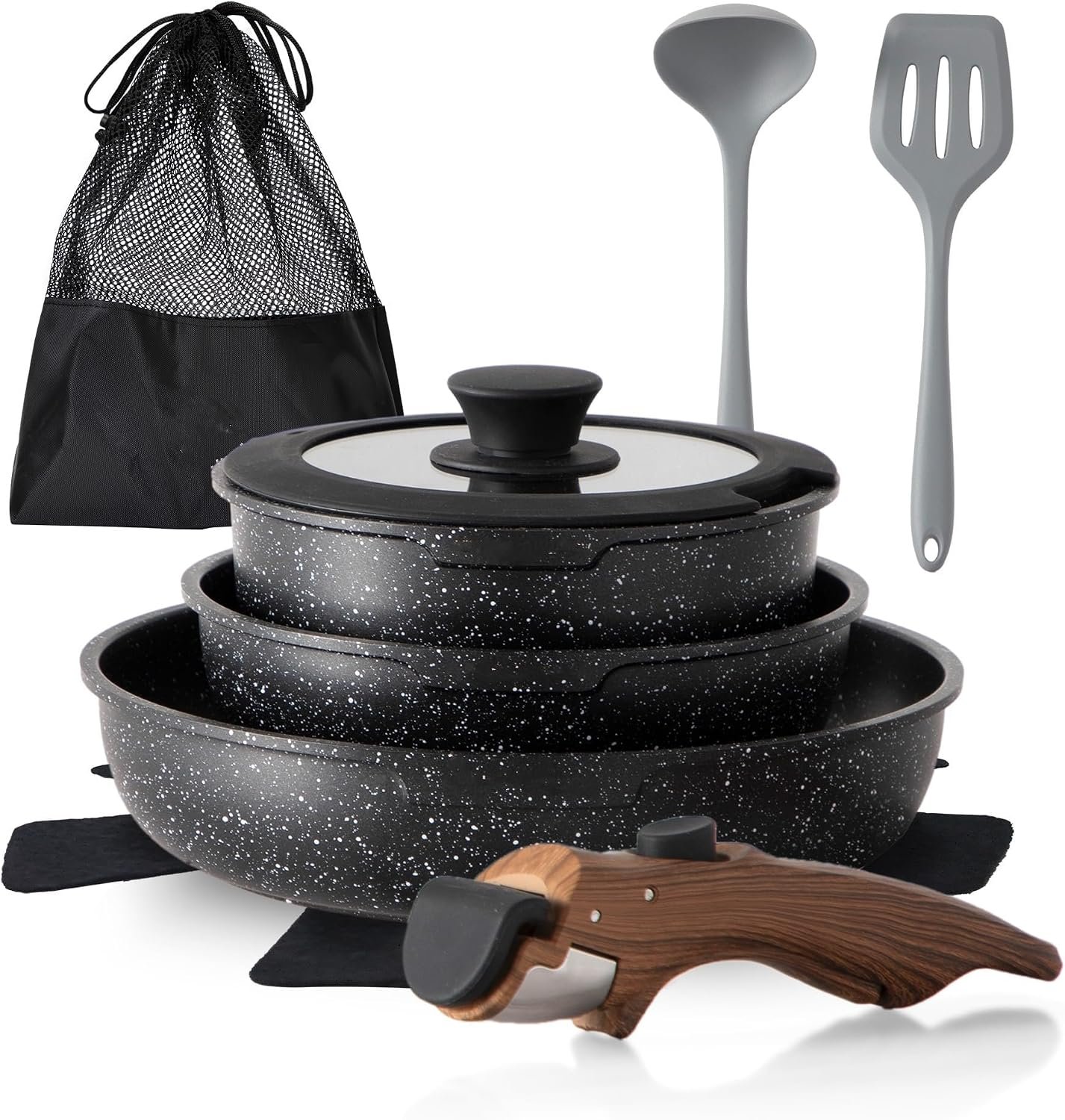
Kitchen cookware has evolved considerably over the years. Traditional pots and pans remain essential, but modern kitchens increasingly make use of designs that focus on flexibility, storage efficiency, and multifunctional cooking. One example is cookware with removable handles, a design that allows pots and pans to be used in different ways while taking up less space when stored.
The Removable Handle Pots and Pans 10-Piece Cookware Set is designed around this concept. It combines a nonstick cooking surface with detachable handles, creating a cookware arrangement that can be useful for everyday stovetop cooking, food preparation, serving, and storage. Depending on the specific configuration and compatibility of the cookware, removable-handle designs can also make it easier to move cookware between different areas of the kitchen.
For households with limited cabinet space, the ability to remove a handle can be particularly interesting. Conventional pans often require additional clearance because their long handles extend outward. A detachable handle can reduce the overall footprint when cookware is stacked or stored.
At the same time, cookware with removable handles introduces a few considerations that do not apply in exactly the same way to traditional fixed-handle pans. Users need to understand how the handle attaches, how it should be removed, what surfaces the cookware is compatible with, and which cleaning or cooking methods are recommended.
This guide explains the main characteristics of removable-handle cookware, practical ways to use a 10-piece set, the potential benefits of nonstick cookware, important care considerations, and how this type of set compares with other general cookware categories.
What Is Removable-Handle Cookware?
Removable-handle cookware is designed with a handle that can be detached from the main cooking vessel.
Traditional cookware usually has a permanently attached handle. This works well for everyday stovetop cooking, but it also means the pan occupies more space when placed inside a cabinet, drawer, oven, refrigerator, or other storage area.
A removable handle changes that arrangement.
When the handle is attached, the cookware can be handled much like a conventional pan. Once the cooking or storage task is complete, the handle can be detached according to the manufacturer’s instructions.
This design can provide greater flexibility in kitchens where storage space is limited.
The concept is also useful when several pieces of cookware need to be stored together. Without long handles extending from every pan, cookware can often be nested more efficiently, although the exact storage arrangement depends on the shape and dimensions of the individual pieces.
Key Features
Several characteristics define this type of cookware set.
10-Piece Cookware Configuration
A 10-piece set is intended to provide multiple cookware components within one coordinated collection.
The exact contents of a cookware set can vary, so users should always check the current product listing for the precise pieces included.
A multi-piece set can be useful because it allows different cookware sizes and shapes to serve different cooking purposes.
For example, one pan may be suitable for sautéing vegetables, another for preparing eggs or smaller portions, while a larger pot may be more practical for pasta, soups, or family-sized meals.
Having multiple pieces also reduces the need to purchase every item individually.
Removable Handles
The defining feature is the detachable handle system.
When attached securely, the handle provides the leverage necessary to lift and maneuver the cookware.
When removed, the pan becomes more compact.
This can be useful for several situations, including storage and transferring cookware where the handle would otherwise take up unnecessary space.
The attachment mechanism should always be operated according to the manufacturer’s instructions. Users should make sure the handle is properly secured before lifting a pan containing hot food.
Nonstick Cooking Surface
Nonstick cookware is designed to reduce the tendency of food to adhere to the cooking surface.
This can be useful when preparing foods such as eggs, pancakes, fish, vegetables, or other ingredients that may be difficult to release from a conventional cooking surface.
A nonstick surface can also make cleanup easier because food residue may be less likely to become firmly bonded to the pan.
However, nonstick cookware requires appropriate care. Metal utensils, abrasive cleaning materials, overheating, and improper storage can potentially damage some nonstick surfaces.
The manufacturer’s care recommendations should therefore take priority.
Space-Efficient Design
One of the main practical reasons to consider removable handles is storage.
A conventional frying pan can take up considerable horizontal space because its handle extends far beyond the cooking surface.
Removing the handle can make the pan easier to stack or arrange in a cabinet.
This can be particularly useful in apartments, smaller kitchens, RV kitchens, or households where cabinet space is limited.
Potential Versatility
Removable-handle cookware can be particularly flexible because the same pan may serve different roles depending on the cooking and storage situation.
For example, a pan can be used on the stovetop with its handle attached and then prepared for storage after the handle is removed.
The exact cooking applications depend on the manufacturer’s specifications, including stovetop compatibility and any limitations concerning oven or other appliance use.
Why Choose a Removable Handle?
The handle may appear to be a relatively small part of a pan, but its design can have a significant effect on how cookware is stored and handled.
Easier Storage
Removing the handle reduces the overall footprint of the cookware.
Instead of arranging several long handles around one another, users can store the main cookware pieces without the handles attached when appropriate.
This can make cabinets less crowded.
Better Stacking
Pans can often be nested more efficiently when handles are not extending from their sides.
Nesting should still be done carefully. Nonstick cooking surfaces should be protected from unnecessary scratching or impact, particularly when one pan is placed inside another.
More Flexible Countertop Organization
Long handles can interfere with other items on a crowded countertop.
Removing the handle when cookware is not actively being moved can create a more compact arrangement.
This can be helpful in kitchens where every section of available space serves multiple purposes.
Convenient for Compact Kitchens
Small kitchens often require cookware that can perform multiple functions without requiring large amounts of storage space.
A removable-handle set addresses the storage side of this challenge.
Instead of relying on a separate pan for every cooking task, users can organize a coordinated set in a smaller cabinet area.
How It Can Be Used
A cookware set becomes more useful when each piece is matched to the right type of cooking.
Preparing Breakfast
Nonstick pans are commonly used for breakfast foods.
Eggs, omelets, pancakes, and other foods that can stick to cooking surfaces can benefit from a suitable nonstick pan.
The removable handle can remain attached while the pan is being moved around the stovetop.
When finished, the handle can be removed according to the instructions before the cookware is stored.
Sautéing Vegetables
A frying or sauté pan can be useful for vegetables.
A small amount of cooking oil can be used depending on the recipe and cooking surface.
The nonstick surface may help reduce sticking and can make the pan easier to clean afterward.
Vegetables can be sautéed individually or combined with meat, grains, pasta, or sauces.
Cooking Meat
Different pan sizes can accommodate different portions of meat.
Chicken pieces, ground meat, sausages, or smaller cuts can be prepared in an appropriately sized pan.
When using nonstick cookware for meat, temperature management remains important. Extremely high heat is not automatically better for browning, and cookware should always be used within the temperature limits specified by its manufacturer.
Preparing Sauces
A saucepan or smaller cooking vessel can be useful for sauces, gravies, reheating, and other liquid-based preparations.
A nonstick interior can make some sauce cleanup easier, although users should still avoid aggressive scraping.
Cooking Pasta and Grains
Larger cookware pieces can be useful for pasta, rice, grains, soups, and other dishes that require additional capacity.
The removable-handle concept can be particularly useful when the cookware is not being used on the stovetop because the handle can potentially be removed for more compact storage, depending on the product’s instructions.
Reheating Food
Cookware can also be used for reheating leftovers on the stovetop.
Nonstick surfaces may help prevent food from sticking while reheating, especially when a suitable amount of liquid or oil is incorporated into the recipe.
As with all cookware, heating should be controlled rather than excessive.
Cooking With Nonstick Cookware
Nonstick cookware can change the way certain foods behave during cooking.
Because the cooking surface is designed to reduce sticking, users may not need as much cooking fat as they would with some traditional surfaces.
That does not mean oil should never be used.
The amount of oil depends on the recipe, food type, temperature, and desired result.
Lower to Moderate Heat
Many nonstick cookware products are intended for low to moderate heat rather than prolonged exposure to extremely high temperatures.
Following the manufacturer’s temperature guidance is important.
Preheating an empty nonstick pan for an extended period should generally be avoided unless specifically permitted by the manufacturer.
Appropriate Utensils
Utensil selection matters.
Wooden, silicone, or other utensils recommended for nonstick cookware can help reduce the likelihood of scratching.
Metal utensils may damage some nonstick coatings, so they should only be used if explicitly permitted by the manufacturer.
Gentle Cleaning
A nonstick surface is generally better served by gentle cleaning methods.
Harsh abrasives and aggressive scrubbing can shorten the useful life of some nonstick cookware.
Cleaning instructions can vary by product, so the manufacturer’s recommendations should be followed.
Who It May Be Suitable For
Removable-handle cookware can appeal to several types of households.
People With Limited Storage
This is one of the clearest use cases.
Small cabinets can become crowded quickly when every frying pan has a fixed handle.
Removing handles can help create a more compact storage arrangement.
Apartment Residents
Apartment kitchens often have less storage space than large residential kitchens.
A multi-piece set with detachable handles can provide several cooking options while helping reduce the space required for storage.
Small Families
A multi-piece set can provide different cooking sizes for households that prepare meals ranging from individual portions to larger dishes.
Students and Young Professionals
People setting up a first kitchen may prefer a coordinated cookware set rather than collecting individual pans over time.
A 10-piece configuration can provide a starting collection for common cooking tasks.
Home Cooks Who Value Organization
Some cooks prefer keeping their kitchen equipment neatly arranged.
Removable handles can make it easier to organize cookware by allowing pans to be nested without long handles getting in the way.
People Looking for Multifunctional Cookware
The combination of several cookware pieces and detachable handles can provide flexibility for everyday meal preparation.
However, users should check the exact compatibility of the set before assuming that every piece can be used in every cooking appliance.
Important Things to Consider
Removable-handle cookware has advantages, but there are several practical points worth checking.
Handle Attachment
The handle is a critical safety component.
Before lifting cookware containing hot food, confirm that the handle is attached correctly and securely.
Users should become familiar with the attachment and release mechanism before cooking with the set.
Avoid attempting to remove the handle while the cookware is unstable or positioned in a way that could cause spills.
Weight of the Cookware
A full pan can be considerably heavier than an empty pan.
The handle and attachment mechanism must therefore be used appropriately when moving food.
Avoid lifting cookware by an improperly attached handle.
Stovetop Compatibility
Not every cookware set works with every stovetop.
Depending on the construction, cookware may be compatible with gas, electric, ceramic, induction, or multiple cooking surfaces.
The product specifications should be checked before use, especially if induction compatibility is important.
Oven Compatibility
Removable handles sometimes make cookware designs more suitable for certain oven applications, but users should never assume that a pan is oven-safe simply because its handle can be removed.
Oven compatibility depends on the materials and design of the specific cookware.
If oven use is supported, the manufacturer’s stated temperature limits and instructions should be followed carefully.
Dishwasher Compatibility
Dishwasher compatibility varies among cookware products.
Some nonstick cookware is designed for dishwasher use, while other products recommend hand washing to help preserve the cooking surface.
The care instructions for the specific set should be followed rather than relying on general assumptions.
Storage Between Pans
If the pieces are nested, consider how their surfaces interact.
Placing one nonstick pan directly inside another can potentially cause scratches if the cookware moves around.
Protective separators or careful arrangement may be appropriate if recommended by the manufacturer.
Handle Storage
The removable handle is itself a component that needs a place in the kitchen.
The storage advantage comes from removing the handle from the cookware, but the handle still needs to be stored somewhere accessible.
A good kitchen organization system should account for both the cookware and the detachable components.
Maintaining a Nonstick Cookware Set
Proper care can help maintain cookware performance over time.
Avoid Abrasive Materials
Abrasive pads and harsh cleaning materials may damage a nonstick surface.
A soft sponge or other cleaning method recommended by the manufacturer is generally more appropriate.
Do Not Overheat Empty Cookware
Excessive heating can place unnecessary stress on cookware.
When preheating is appropriate, follow the manufacturer’s recommendations and avoid leaving an empty pan over high heat for extended periods.
Use Suitable Utensils
Choose utensils that are compatible with the nonstick surface.
Silicone and wooden utensils are common choices, although the manufacturer’s recommendations should take priority.
Allow Cookware to Cool Appropriately
Moving very hot cookware directly into cold water can create unnecessary thermal stress in some materials.
Allowing cookware to cool appropriately before cleaning can be a sensible maintenance habit.
Dry Thoroughly
After washing, cookware should be dried according to the manufacturer’s care recommendations before being stored.
Proper drying also helps keep cabinets and storage areas cleaner.
Removable Handle Cookware vs. Traditional Cookware
Traditional cookware generally uses permanently attached handles.
This design is straightforward and familiar. The handle is always available, so there is no separate attachment mechanism to operate.
The main limitation is storage.
Long handles increase the footprint of the pan and can make stacking more difficult.
Removable-handle cookware takes a different approach. It adds a detachable component in exchange for greater storage flexibility.
This means the choice is not simply about cooking performance. It is also about kitchen organization and how the cookware fits into the user’s daily routine.
Someone with plenty of cabinet space may not consider detachable handles particularly important.
For someone with limited storage, the difference can be much more meaningful.
Removable Handle Cookware vs. Stackable Cookware
Some cookware sets are specifically designed to nest or stack even though the handles remain attached.
These designs can save space without requiring users to remove the handle.
The advantage is simplicity.
However, fixed handles still occupy some space and may limit how tightly the cookware can be arranged.
Removable handles can potentially provide a more compact configuration.
On the other hand, the detachable system introduces an additional component that must be attached and stored.
The best choice depends on whether the user prioritizes maximum compactness or a simpler fixed-handle design.
Nonstick Cookware vs. Stainless Steel
Stainless steel cookware is known for its durability and ability to handle a wide range of cooking techniques.
It can also tolerate high temperatures depending on its construction.
However, food may stick more readily when the cooking technique, temperature, or amount of cooking fat is not appropriate.
Nonstick cookware is designed specifically to reduce sticking.
This can make it convenient for delicate foods and everyday cooking.
The tradeoff is that nonstick surfaces generally require more attention to utensil selection, heat management, and cleaning practices.
Neither category is universally suitable for every task.
Some kitchens use both.
Nonstick Cookware vs. Cast Iron
Cast iron cookware is valued for heat retention and versatility.
It can be used for many high-heat cooking applications and can develop a cooking surface through seasoning and maintenance.
However, cast iron can be heavy and may require more specialized care.
A nonstick cookware set is typically lighter and designed for easier food release.
For everyday foods such as eggs, pancakes, and quick sautéed meals, nonstick cookware can be particularly convenient.
For high-heat searing and other specialized applications, cast iron may be preferred by some cooks.
The appropriate cookware depends on the type of food being prepared and the desired cooking method.
Organizing a Small Kitchen With Removable Handles
The storage advantage of detachable cookware becomes especially noticeable when cabinet space is limited.
One practical approach is to place the largest cookware pieces at the bottom of a cabinet and nest smaller pieces inside them where appropriate.
The removable handles can be stored separately in an accessible location.
Before nesting, make sure the cookware surfaces are protected from unnecessary friction or impact.
Another option is to organize cookware vertically using an appropriate cabinet organizer, with handles stored alongside the pieces.
The goal is to create a system where the cookware can be retrieved quickly without requiring the user to move an entire stack.
Cooking Safety With Detachable Handles
Safety should always come before convenience.
Before using the cookware, inspect the handle attachment mechanism and make sure it is clean and functioning as intended.
When the handle is attached, confirm that it is properly locked before moving the pan.
Never assume that the handle is secure simply because it appears to be connected.
Avoid releasing or attaching the handle in a way that could cause hot food to spill.
When cooking on a stovetop, keep handles positioned safely according to the manufacturer’s instructions and normal kitchen safety practices.
Children should also be kept away from hot cookware and detachable components.
Planning Meals With a Multi-Piece Set
A multi-piece cookware collection can simplify meal preparation because different pieces can be assigned to different stages of a recipe.
For example, a larger pot can be used for pasta while a separate pan handles vegetables or sauce.
For a one-pan meal, a larger frying or sautéing vessel may be sufficient.
For breakfast, a smaller pan can be convenient for individual servings.
The key benefit of having multiple sizes is not simply the number of pieces. It is the ability to choose a vessel that matches the quantity of food being prepared.
Using a pan that is excessively large for a small portion can make certain cooking tasks less efficient, while an undersized pan can cause overcrowding.
Common Mistakes to Avoid
A few habits can reduce the lifespan of nonstick cookware or create unnecessary safety risks.
Using Excessive Heat
High heat is not necessary for every cooking task and may be inappropriate for some nonstick cookware.
Use the heat level appropriate for the recipe and cookware.
Scraping With Sharp Utensils
Sharp or metal utensils can potentially damage some nonstick surfaces.
Choose compatible tools.
Removing a Hot Handle Without a Plan
Detachable handles should be operated according to their intended mechanism.
Do not improvise when removing or attaching a handle around hot food.
Ignoring Weight Limits
A full pot or pan can place considerably more stress on the handle than an empty one.
Handle cookware carefully and stay within the manufacturer’s intended use.
Storing Cookware While Wet
Moisture left on cookware can create an undesirable storage environment.
Dry pieces appropriately before putting them away.
Assuming Every Appliance Is Compatible
Removable handles do not automatically mean that cookware can be used in an oven, induction cooktop, dishwasher, or other appliance.
Check the specifications for each use.
Frequently Asked Questions
What is removable-handle cookware?
Removable-handle cookware is designed with handles that can be attached and detached from the main cookware body. The design can provide greater flexibility during cooking and storage.
What is included in a 10-piece cookware set?
The exact contents can vary by product. Users should consult the current product listing for the specific pieces and accessories included in the 10-piece configuration.
Why would someone want removable handles?
The main advantage is storage flexibility. Removing the handles can reduce the overall footprint of pans and make them easier to stack or organize in smaller cabinets.
Is removable-handle cookware suitable for small kitchens?
It can be particularly useful in small kitchens because removing handles can reduce the space required to store cookware.
Is the cookware nonstick?
The product is described as a nonstick cookware set. Nonstick cookware is designed to reduce food adhesion and can simplify certain cooking and cleanup tasks.
Can metal utensils be used with nonstick cookware?
That depends on the manufacturer’s specifications. Some nonstick surfaces can be scratched or damaged by metal utensils, so using utensils recommended for the specific cookware is generally advisable.
Can the handles be removed while the pan is hot?
Handle removal should only be performed according to the manufacturer’s instructions and in a manner that avoids burns, spills, or instability. Users should never improvise with a hot pan.
Can removable-handle cookware be used on an induction cooktop?
Compatibility depends on the specific cookware construction. If induction cooking is important, check the product specifications before use.
Can the cookware go in the oven?
Oven compatibility depends on the individual cookware design and manufacturer’s instructions. A removable handle alone does not guarantee oven safety.
Can the cookware be placed in a dishwasher?
Dishwasher compatibility varies. Check the manufacturer’s care instructions before placing any piece in a dishwasher.
How should nonstick cookware be cleaned?
Gentle cleaning methods are generally preferable. Avoid abrasive materials and follow the specific cleaning instructions supplied with the cookware.
How can nonstick cookware be protected from scratches?
Use compatible utensils, avoid abrasive cleaning tools, and take care when stacking pieces. Protective separators may also be useful when appropriate.
Is a removable handle stronger than a fixed handle?
A removable handle is designed around a different attachment system, but users should not assume that it has the same characteristics as a permanently attached handle. Always follow the stated handling and weight guidance.
Can the cookware be nested?
Removable handles can make nesting more practical because the handles do not have to extend from each pan. However, cookware should be nested carefully to avoid damaging nonstick surfaces.
Does removing the handle make cookware easier to store?
It can. Without a long handle extending from the side, the cookware generally occupies a smaller footprint.
Can one cookware set handle everyday meals?
A multi-piece set can cover many everyday cooking tasks, depending on the specific pieces included and their sizes.
Is nonstick cookware good for eggs?
Nonstick surfaces are commonly used for eggs because they are designed to reduce food sticking. Heat management and suitable utensils remain important.
Can nonstick cookware be used with high heat?
The appropriate temperature depends on the specific cookware. Users should follow the manufacturer’s recommended heat limits rather than assuming all nonstick cookware can tolerate prolonged high temperatures.
What should be checked before using the detachable handle?
Check that the handle is clean, undamaged, and correctly attached according to the manufacturer’s instructions. Make sure it is securely locked before lifting cookware.
Does removable-handle cookware require special care?
It can require some additional attention because the handle attachment mechanism needs to be used correctly. The nonstick cooking surface also benefits from appropriate heat, utensils, cleaning, and storage practices.
Is a 10-piece set suitable for beginners?
A multi-piece cookware set can provide a useful starting collection for someone setting up a kitchen. Beginners should become familiar with the included pieces, handle mechanism, cooking compatibility, and care instructions before regular use.
Conclusion
Removable-handle cookware offers a practical approach to one of the most common challenges in modern kitchens: balancing cooking versatility with limited storage space.
The 10-piece nonstick cookware concept combines several useful ideas in one collection. Multiple cookware pieces can support different meal-preparation tasks, while the nonstick cooking surfaces are designed to make food release easier for many everyday dishes. The detachable handle adds another layer of flexibility by allowing cookware to be stored without the long handles associated with conventional pans.
This can be particularly valuable in compact kitchens, apartments, small households, or any cooking environment where cabinet organization matters.
At the same time, removable handles require responsible use. The attachment mechanism should be checked before lifting cookware, especially when the pan contains hot or heavy food. Compatibility with stovetops, ovens, dishwashers, and other appliances should be confirmed rather than assumed. Nonstick surfaces should also be treated carefully, with appropriate utensils, heat levels, cleaning methods, and storage practices.
Compared with conventional fixed-handle cookware, the biggest distinction is not necessarily the ability to prepare different foods. Both types can handle many of the same everyday cooking tasks. The major difference is how the cookware fits into the kitchen when it is not being used.
For cooks who value compact storage and a coordinated cookware collection, removable-handle pots and pans can offer an interesting solution. The most suitable choice ultimately depends on the household’s cooking habits, kitchen layout, storage requirements, and preferred maintenance routine.
As with any cookware purchase, checking the exact specifications and care instructions is important before use.
Leave a Reply